


How Children Develop Writing Muscle Memory
Writing muscle memory is defined as the brain’s ability to automate precise hand and finger movements through repeated practice until handwriting becomes fluid and effortless. For children aged 3 to 6, this process is far more complex than simple repetition. It weaves together fine motor skills, visuospatial processing, and executive functions like working memory and cognitive flexibility. Understanding how children develop writing muscle memory gives parents and educators a real advantage. You can structure practice smarter, recognize progress earlier, and choose tools that match where your child actually is developmentally.
How children develop writing muscle memory: the brain-body connection
Writing muscle memory is not purely a motor skill. Research confirms it is deeply integrated with cognitive development, especially the executive functions that coordinate attention, sequencing, and error correction during handwriting. This distinction matters because it changes how you practice.
Three neurological systems work together every time a child picks up a pencil:
- Motor execution: Fine motor precision, proprioception (the body’s sense of where the hand is in space), and sustained motor speed all determine how cleanly a child forms each letter stroke. Neural changes in visuomotor processing and attentional control support this skill as it develops.
- Working memory: This is the brain’s temporary workspace. It holds the visual shape of a letter while the hand reproduces it, manages stroke sequencing, and tracks spatial layout on the page. Without working memory, a child cannot reliably reproduce a letter they have just seen.
- Executive flexibility: This allows a child to shift quickly between tasks, catch errors mid-stroke, and adjust pressure or direction. It is the cognitive “editor” running in the background during every writing session.
“Automatizing handwriting frees working memory resources, thereby enabling better focus on higher-order writing tasks like composition.” — Motor and cognitive determinants of handwriting fluency
This quote captures the real goal of muscle memory development. When letter formation becomes automatic, the child’s brain stops spending energy on how to write and starts spending it on what to write. That shift is the foundation of literacy.
How does structured practice build and reinforce muscle memory?
Repetition builds muscle memory, but the structure of that repetition determines how fast and how durably the skill sticks. A University of Lisbon study found that 16 sessions of 30 minutes each, held twice weekly, produced significant improvements in fine motor control and writing quality in preschoolers. Gains were maintained six months later. That result points to a clear principle: short, consistent sessions outperform long, infrequent ones every time.
Effective practice follows a natural progression:
- Large motor movements first. Before a child traces letters, they benefit from drawing wide circles, zigzags, and loops in the air or on large paper. These movements build the shoulder and wrist control that smaller strokes depend on.
- Visual-motor copying. Children trace over dotted or faded letters, learning to match what they see with what their hand produces. Repeated tracing and copying internalize letter shapes and stroke direction at a neurological level.
- Consistent letter reproduction. Once a child can copy reliably, the goal shifts to reproducing letters from memory with consistent size, spacing, and pressure. This is where true automation begins.
- Cursive and connected writing. Research on Grade 3 students shows that structured cursive instruction produces significant gains in writing fluency and hand coordination. Cursive naturally encourages continuous hand movement, which deepens muscle memory faster than isolated print letters.
Pro Tip: Keep individual practice sessions to 10 to 15 minutes for children under 6. Fatigue degrades motor precision quickly, and a tired hand reinforces sloppy habits rather than clean ones. Two short sessions per day beat one long session every time.
Tracing activities work best when they include pattern exercises, not just letters. Repeating waves, spirals, and diagonal lines trains the fine motor pathways that letter strokes share. Think of it as building the road before driving the car.
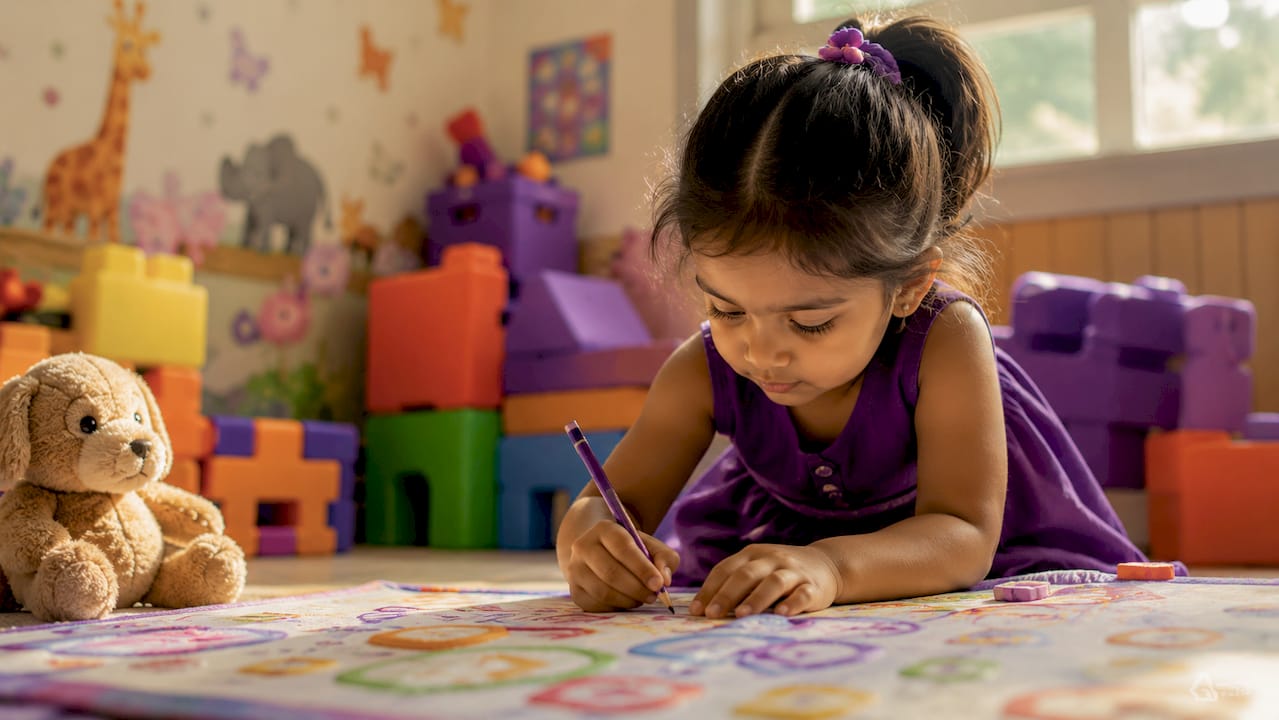
What are the developmental stages of handwriting muscle memory?
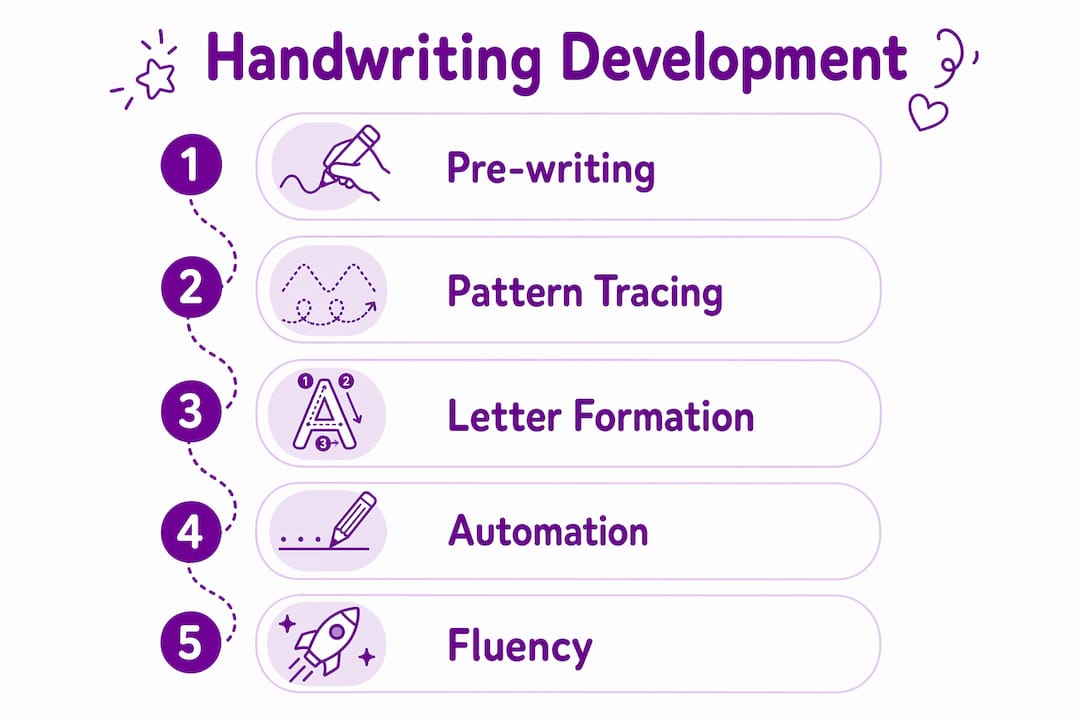
Recognizing where your child is in the process helps you set realistic expectations and choose the right activities. Muscle memory development in writing follows a predictable arc, though the pace varies by child and by the complexity of the writing system being learned.
Watch for these markers at each stage:
- Early stage (ages 3 to 4): Letter formation is inconsistent. The child may reverse letters, vary size dramatically, and write slowly with visible effort. This is completely normal. The brain is still building the visual templates that muscle memory will eventually automate.
- Building stage (ages 4 to 5): Stroke direction becomes more consistent. The child begins to recognize their own errors and self-correct. Writing speed increases slightly, though it still requires significant concentration.
- Consolidation stage (ages 5 to 7): Handwriting automation continues developing well beyond kindergarten, with notable improvement typically appearing after Grade 2. Children writing in complex orthographies (like Hindi or Punjabi, which feature more intricate letter forms) may take longer to reach automation.
- Fluency stage: The child writes with smoothness and rhythm. Letter formation no longer requires conscious attention. Cognitive load during writing drops visibly. You will notice the child can hold a conversation or think about content while writing, rather than focusing entirely on the physical act.
One practical way educators measure automation is through fast copying tasks. A common method involves 1-minute vowel copying to track how efficiently a child’s muscle memory is consolidating. Speed and accuracy together signal genuine automation, not just careful slow writing.
Children learning to write in writing readiness activities benefit from starting with pre-writing patterns before formal letter instruction begins. This builds the motor foundation that makes later automation faster and more stable.
How do working memory and executive flexibility shape handwriting fluency?
Raw motor ability is not the primary driver of handwriting quality in older children. A 2026 Frontiers study found that visuospatial working memory and executive flexibility independently predict handwriting fluency in children aged 10 to 12, beyond motor skill alone. This finding reframes how we think about children who struggle with legibility or speed despite adequate physical coordination.
| Cognitive factor | Role in handwriting | What it looks like when underdeveloped |
|---|---|---|
| Visuospatial working memory | Holds letter shapes and spatial layout in mind during writing | Inconsistent letter size, poor spacing, losing place on the page |
| Executive flexibility | Enables error detection and mid-task adjustment | Persisting with incorrect strokes, difficulty self-correcting |
| Sustained attention | Maintains motor precision over the length of a writing task | Handwriting that deteriorates noticeably toward the end of a page |
These cognitive factors interact with motor skills rather than replacing them. A child with strong motor control but weak working memory will still struggle with layout and sequencing. A child with excellent working memory but underdeveloped fine motor skills will know what the letter should look like but lack the physical precision to produce it cleanly.
Pro Tip: If a child’s handwriting is inconsistent rather than uniformly poor, the issue is more likely cognitive (working memory or attention) than purely motor. Try shorter writing tasks with more frequent breaks before assuming the child needs more physical practice.
Play-based learning directly supports both working memory and executive flexibility. Activities like building with blocks, threading beads, and drawing from imagination train the same cognitive systems that handwriting relies on, without the pressure of formal writing tasks.
Key takeaways
Children develop writing muscle memory through the combined development of fine motor skills and cognitive systems, with consistent structured practice being the single most powerful driver of lasting improvement.
| Point | Details |
|---|---|
| Muscle memory is cognitive and motor | Executive functions and working memory are as critical as fine motor skill in handwriting development. |
| Short sessions work best | Twice-weekly sessions of 30 minutes each produce sustained gains, with effects lasting six months or more. |
| Automation develops gradually | Significant handwriting consolidation typically appears after Grade 2, not in kindergarten. |
| Cognitive factors predict fluency | Visuospatial working memory and executive flexibility independently predict handwriting speed and accuracy in children. |
| Tracing and copying build the foundation | Repeated tracing internalizes letter shapes neurologically, forming the basis for automatic letter production. |
What I’ve learned from watching children write one letter at a time
I have spent years watching children approach a blank page, and the most common mistake I see adults make is treating handwriting practice as purely physical. Parents buy lined notebooks and ask children to fill them with repeated letters, then wonder why progress stalls. The research is clear on this: handwriting fluency depends on cognitive system interactions, not just hand strength or repetition volume.
What actually moves the needle is engagement. A child who is genuinely interested in what they are tracing will practice longer, self-correct more readily, and retain the motor pattern more durably. That is not a soft observation. It reflects how attention and working memory function. Motivated attention strengthens the neural encoding of motor sequences.
I also think we underestimate how much cultural connection fuels writing motivation. When a child traces letters that connect them to their family’s language and heritage, the emotional investment is real. That investment translates directly into the sustained, repeated practice that builds muscle memory. It is not magic. It is neuroscience wearing a warm coat.
My honest advice: celebrate smoothness, not speed. When a child’s letters start to flow without visible effort, that is the sign that muscle memory is consolidating. Speed will follow. Pushing for speed before fluency is established tends to reinforce rushed, inconsistent strokes that are harder to correct later.
— Bobby
Give your child the gift of magical writing practice

Littlepumpkins designs tracing books that make writing practice feel like play. Their reusable magic ink books let children aged 3 to 6 trace letters in English, Punjabi, Hindi, and more, building fine motor skills and muscle memory one stroke at a time. The magic ink technology means every page can be used again and again, giving children the repeated practice that research shows is the real driver of handwriting automation. Explore the full range of tracing and handwriting practice books to find the perfect fit for your child’s age and language background. For alphabet-focused practice, the English alphabet tracing book is a wonderful starting point.
FAQ
What is writing muscle memory in children?
Writing muscle memory is the brain’s ability to automate handwriting movements through repeated practice, so letter formation becomes fluid without conscious effort. It involves both fine motor skills and cognitive systems including working memory and executive functions.
At what age do children start developing handwriting muscle memory?
Children begin building the motor and cognitive foundations for handwriting muscle memory as early as age 3, but significant automation typically consolidates after Grade 2, around ages 7 to 8.
How much practice does a child need to build writing muscle memory?
Research supports short, consistent sessions rather than long infrequent ones. A structured program of twice-weekly 30-minute sessions over several months produces lasting improvements in fine motor control and writing quality.
Why does my child’s handwriting look different every time they write?
Inconsistent letter formation is a normal sign of early-stage muscle memory development. It reflects the brain still building reliable visual-motor templates. Consistent, structured tracing practice helps stabilize letter formation over time.
Does learning to write in multiple languages affect muscle memory development?
Yes. Children learning complex orthographies like Hindi or Punjabi may take longer to automate letter formation due to the greater intricacy of the letter shapes. Knowing how to recognize writing readiness in your child helps you time multilingual writing practice appropriately.