


How Magic Ink Writing Books Work for Kids
Magic ink writing books are reusable educational tools that combine grooved pages with disappearing ink technology to teach children handwriting and multilingual scripts. The ink fades completely within 15–30 minutes, resetting the page for another round of practice. Products like the Sank Magic Practice Copybook and Littlepumpkins’ tracing books use this same core mechanism to help children aged 3–8 build fine motor skills, letter recognition, and writing confidence. Understanding how magic ink writing books work helps you choose the right tool and use it well.
How magic ink writing books work: grooves and ink together
The real engine behind these books is not just the ink. Physical grooves pressed into each page guide a child’s pen along the correct path for every letter or number. The groove depth and pattern are calibrated to match typical child finger size and pen tip shapes, maximizing tactile feedback for muscle memory. That physical guidance is what builds the handwriting habit. The ink is the reward.

The disappearing ink itself is a proprietary formula. It fades through a chemical process, not UV light or heat activation. This means no special lamp or device is needed. The page simply clears on its own, ready for the next attempt.
Here is how the two mechanisms work together in practice:
- Grooves steer the pen tip along the correct stroke path, giving the child physical feedback about direction and pressure.
- Disappearing ink removes the visual record of each attempt, so children feel no shame about imperfect letters and try again freely.
- Silicone grip aids included in sets like the CosyCorner Magic Ink Copybooks teach correct pen posture for children aged 3–6, preventing bad habits before they form.
- Repeated tracing over the same grooves builds muscle memory faster than blank paper practice because the path is always correct.
Pro Tip: Focus your child’s attention on feeling the groove, not watching the ink. The tactile sensation is what trains the hand. The disappearing ink is a confidence tool, not the learning mechanism itself.
The groove is the teacher. The ink is the encouragement.
Magic ink books vs. traditional workbooks: which wins?
Traditional paper workbooks are consumed once and discarded. Magic ink writing books are reusable, which changes the math on both cost and environmental impact. A standard set like the Sank Magic Practice Copybook includes 4 books covering alphabets, numbers, math, and drawing, plus 10 ink refills. That single purchase replaces dozens of disposable workbooks over a child’s early learning years.
The reusable design also removes a subtle but real source of anxiety. When a child writes on paper, the mistake is permanent. They see it, you see it, and the page fills up with evidence of struggle. With magic ink writing explained simply: the page forgets, so the child can too.
| Feature | Magic Ink Books | Traditional Workbooks |
|---|---|---|
| Reusability | Unlimited with refills | Single use only |
| Cost over time | Lower, one purchase plus refills | Higher, repeated buying |
| Environmental impact | Minimal paper waste | High paper consumption |
| Writing anxiety | Low, ink fades and resets | Higher, mistakes are permanent |
| Tactile guidance | Yes, grooved pages | No physical guidance |
| Engagement for kids | High, “magic” element adds fun | Variable, often routine |
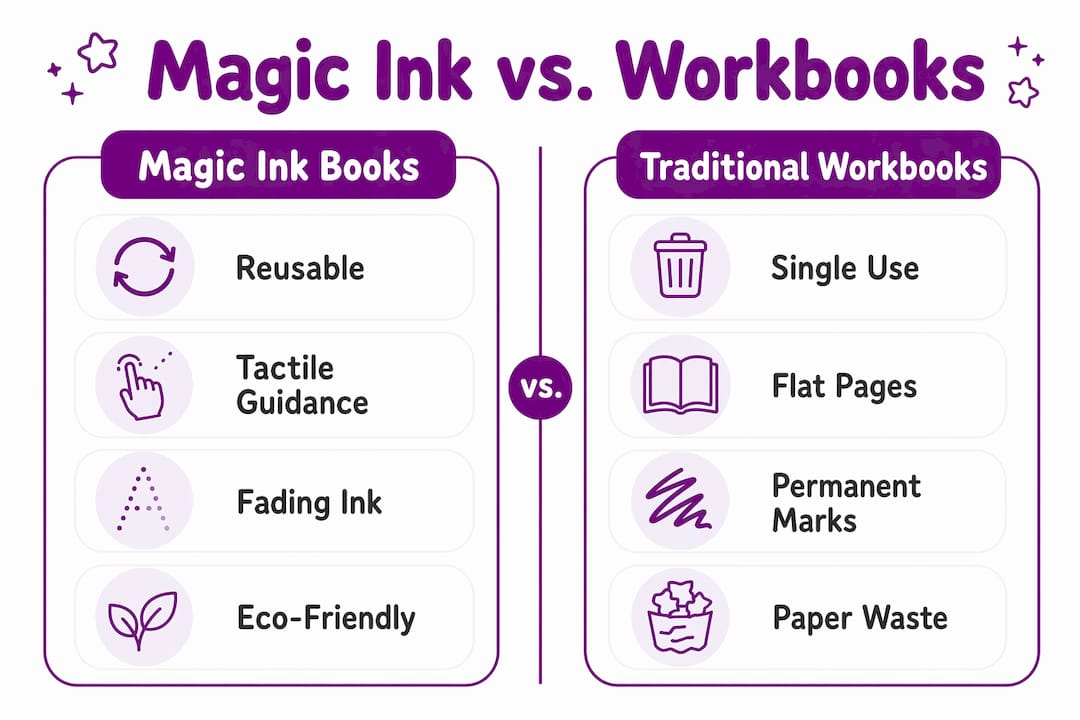
The eco-friendly angle matters to many families and schools. Choosing sustainable learning tools reduces paper waste without reducing practice time. Children can trace the same letter 50 times in a single afternoon without using a single sheet of paper.
How do magic ink books support bilingual handwriting?
Learning to write in two languages at once is genuinely hard for young children. Each script has its own stroke logic, letter shapes, and directional rules. Hindi and Punjabi, for example, use scripts that look nothing like the Latin alphabet. Asking a child to master both simultaneously on paper creates a lot of visible failure.
Magic ink technology solves this by separating motor skill development from visual permanence. The child practices the physical movement of forming a letter without the pressure of producing a perfect, lasting result. That separation is significant. It means a 4-year-old can practice Devanagari strokes the same way they practice English letters, with no extra fear attached to the harder script.
Here is why this matters for bilingual learners specifically:
- Muscle memory builds independently of language. The hand learns the stroke pattern through repetition, regardless of which script it is tracing.
- Fading ink reduces comparison anxiety. Children do not compare their Hindi letters to their English letters and feel discouraged by the difference.
- Frequent repetition is possible. Because the page resets, children can practice a tricky Punjabi character 20 times in one sitting without running out of space.
- Confidence carries over. Early childhood educators report that visual fading reduces anxiety and encourages children to practice longer without fear of mistakes.
Littlepumpkins builds on this principle directly. Their books cover English, Hindi, Punjabi, Gujarati, and Nepali scripts, each with grooved pages designed for that specific alphabet. A child learning both English and Gujarati uses the same physical learning method for both, which keeps the experience consistent and less overwhelming. You can explore Gujarati script practice and Nepali Devanagari tracing as part of a broader multilingual routine.
Research on early language acquisition supports this approach. Children benefit from learning multiple languages young, and removing the fear of written mistakes accelerates that process.
Practical tips for using magic ink books effectively
Understanding magic ink books is one thing. Getting the most out of them daily is another. These tips apply whether you are a parent using them at home or an educator incorporating them into a classroom routine.
- Use only the supplied magic ink pens. The disappearing ink requires proprietary pens. A regular marker or crayon will permanently stain the page and ruin the reusable surface. Keep the magic pens stored separately from the rest of the art supplies.
- Rotate between multiple books while ink fades. Ink fading takes 15–30 minutes depending on room temperature and humidity. Higher humidity or lower temperatures slow the process. Having two or three books in rotation means your child always has a fresh page ready.
- Introduce the silicone grip aid from day one. Correct pen grip is far easier to teach at age 3 than to correct at age 7. The grip aid included in most sets positions small fingers correctly without any instruction from you.
- Set a short, regular practice window. Ten minutes of daily tracing beats one long session per week. Consistency is what converts groove-guided tracing into independent handwriting skill.
- Store pens cap-side down when not in use. This keeps the ink flowing to the tip and extends the life of each pen significantly.
Pro Tip: Label each magic ink pen with your child’s name and keep them in a dedicated pouch. When pens get mixed into a general art box, they disappear fast, and replacing them mid-practice session breaks the learning rhythm.
For a broader look at writing readiness in toddlers, check whether your child is physically ready before introducing groove tracing. Starting too early can create frustration rather than confidence.
Key takeaways
Magic ink writing books work because grooved pages build muscle memory through tactile guidance, while disappearing ink removes the fear of mistakes and resets the page for unlimited practice.
| Point | Details |
|---|---|
| Grooves do the real work | Physical groove guidance builds muscle memory faster than blank paper practice. |
| Ink fades in 15–30 minutes | Ambient conditions affect fading speed, so rotate books to keep practice moving. |
| Proprietary pens are non-negotiable | Regular markers permanently damage pages and destroy reusability. |
| Bilingual learning benefits directly | Fading ink separates motor skill practice from visual pressure, easing multilingual writing. |
| Reusable design saves money and paper | One set replaces dozens of disposable workbooks over a child’s early learning years. |
Why the groove matters more than the magic
I have recommended magic ink books to dozens of parents over the years, and the conversation always starts the same way. Parents are drawn in by the disappearing ink. It feels like a trick, and kids love tricks. That is a perfectly good reason to pick up the book. But the ink is not why the books work.
The groove is why they work. When a child’s pen tip drops into that channel and follows the letter shape, the hand is learning something real. The brain is mapping a movement. That mapping happens whether the ink disappears or not. What the ink does is remove the emotional weight of the permanent record. A child who is nervous about writing, or who has been told their letters look wrong, will pick up a magic ink book and try again. That willingness to try again is everything in early education.
For bilingual families, this combination is especially meaningful. I have seen children who resisted writing in their heritage language completely open up when the stakes felt lower. The page forgets. So they try. And then they try again. Over time, those strokes become natural, and the language feels like theirs.
The eco-friendly aspect is a genuine bonus, not a marketing add-on. Families who care about reducing waste can feel good about a tool that replaces stacks of paper workbooks. Pair these books with play-based writing activities and you have a complete early literacy routine that is both effective and sustainable.
— Bobby
Littlepumpkins magic ink books for early writers
Littlepumpkins designs magic ink tracing books specifically for children aged 3–6 who are learning to write in English, Hindi, Punjabi, Gujarati, or Nepali. Each book features grooved pages and the same disappearing ink technology described throughout this article, sized and shaped for small hands. The illustrations are warm and engaging, so children want to pick the books up.
If you are ready to give your child a writing practice tool that works across languages and lasts through hundreds of sessions, explore the full range of tracing and handwriting books at Littlepumpkins. You will find options for every script your family uses, all built on the same groove-and-fade technology that makes magic ink writing so effective for young learners.
FAQ
What is magic ink writing technology explained simply?
Magic ink writing technology uses a proprietary disappearing ink that fades within 15–30 minutes combined with grooved pages that physically guide a child’s pen. Together, these features allow unlimited reuse and build handwriting muscle memory through repeated tactile practice.
Can regular pens be used in magic ink writing books?
Regular pens permanently stain the grooved pages and destroy the reusable surface. Only the supplied magic ink pens should be used, as the disappearing formula is specific to those pens.
How long does the ink take to disappear?
The ink typically fades within 15–30 minutes, though higher humidity or cooler room temperatures can slow the process. Rotating between two or three books while one resets keeps practice sessions moving without interruption.
Are magic ink books good for bilingual children?
Magic ink books are particularly well suited for bilingual learners because the fading ink separates motor skill practice from the pressure of producing a perfect visual result. Children can practice complex scripts like Hindi or Punjabi repeatedly without anxiety about permanent mistakes.
At what age should children start using magic ink writing books?
Most magic ink writing books are designed for children aged 3–8, with silicone grip aids included to support correct pen posture for the youngest users. Checking for basic writing readiness signs before starting helps set children up for a positive first experience.