


Why Activity Books Support Independent Learning in Kids
Activity books are structured learning tools that enable children to build skills, concentration, and confidence through self-paced, hands-on tasks without constant adult direction. Unlike passive entertainment, they place the child in the driver’s seat of their own learning. The educational term for this approach is self-directed learning, and activity books are one of its most accessible entry points for children aged 3 to 6. Understanding why activity books support independent learning helps parents and educators make smarter choices about the tools they put in front of young children every day.
Why activity books support independent learning
Activity books create the conditions children need to learn on their own. They present a clear task, a defined space to work in, and a visible result when the work is done. That structure is not restrictive. It is actually what makes freedom possible. When a child knows exactly what a page is asking of them, they can attempt it, assess their own progress, and feel the satisfaction of finishing without needing someone to guide every step.
The most effective activity books draw on Montessori-inspired design principles. Preschool busy books provide deliberate, hands-on practice in fine motor, cognitive, and literacy skills through self-directed activities. This mirrors the Montessori idea of the “prepared environment,” where materials are designed so the child can use them independently and learn from the experience itself.
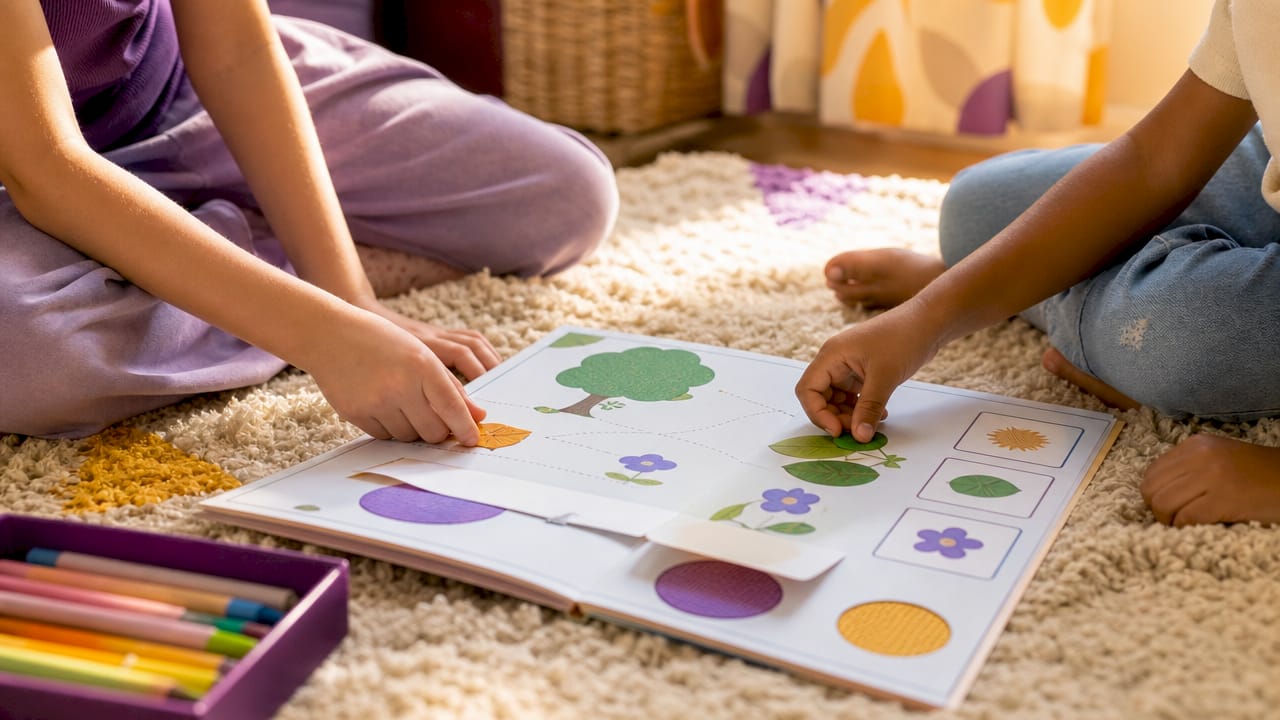
One of the most powerful features of a well-designed activity book is built-in error control. When a child traces a letter incorrectly or places a shape in the wrong spot, the page itself shows the mismatch. No adult needs to intervene. The child sees the problem, tries again, and corrects it. This cycle of attempt, feedback, and correction is exactly how deep learning happens.
High-quality activity books isolate one specific skill per page to prevent overwhelm and maintain the child’s flow state for independent repetition. A page that asks a child to do too many things at once breaks concentration and invites frustration. A page with one clear challenge keeps them focused and moving forward.
- Tactile engagement: Physical interaction with a page triggers deeper concentration than watching a screen. Active tactile tasks enhance concentration more than passive screen time.
- Visible progress: Each completed page gives children proof of their effort, which builds intrinsic motivation to continue.
- Portable autonomy: Activity books work anywhere, with no battery, Wi-Fi, or adult setup required.
- Repeatable practice: Children can return to the same page multiple times, deepening mastery at their own pace.
Pro Tip: Look for activity books where the answer or outcome is visible on the page itself. When children can self-check their work, they practice critical thinking alongside the target skill.
What does research say about activity books and child development?
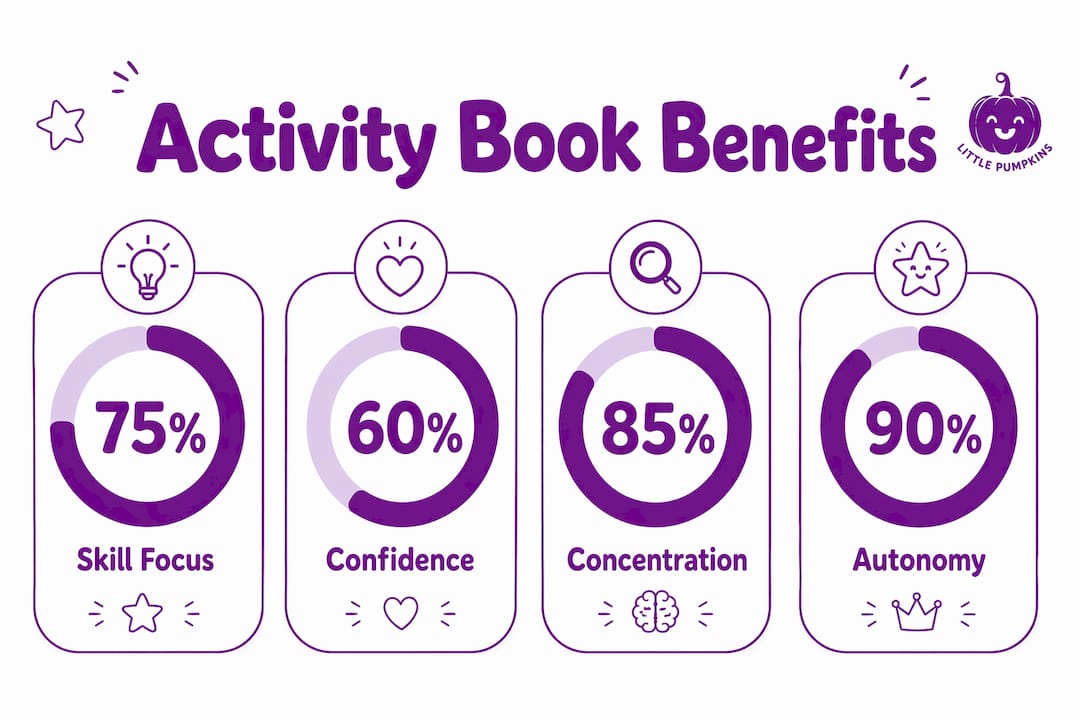
The evidence connecting activity books to developmental gains is specific and encouraging. Consistent engagement with focused, repetitive activity books for 15 to 20 minutes, three nights weekly, improves children’s attention span and supports entering a flow state. That is a meaningful result from a modest time investment. It means a short, regular habit with an activity book can produce cognitive benefits that carry into school readiness and beyond.
The socioemotional gains are equally significant. Child-initiated activities, like independent work in activity books, correlate with higher self-esteem and reduced school anxiety compared to adult-led approaches. Children who regularly complete tasks on their own develop a quiet confidence. They learn that they are capable. That belief becomes the foundation for how they approach new challenges throughout their education.
“Activity books are work stations that nurture autonomy by allowing children to start, complete, and clean up tasks independently, reinforcing self-reliance.” — The Montessori House
This framing matters. When you think of an activity book as a workstation rather than a toy, you see it differently. It is not something to keep a child busy. It is a structured opportunity for them to practice being capable. Repeated independent task cycles build autonomy in ways that adult-directed learning simply cannot replicate.
Research also points to the role of productive struggle. Productive failure experienced through activity books fosters cognitive persistence essential for academic success. When a child wrestles with a tracing line or a matching puzzle and eventually gets it right, they are not just learning the skill. They are learning that effort leads to results. That lesson is more valuable than any single correct answer.
Tactile experiences in Montessori-aligned activity books create sensory-rich learning that supports executive function and intrinsic motivation. Executive function, which includes planning, focus, and impulse control, is one of the strongest predictors of long-term academic success. Activity books train it quietly, one page at a time.
How do activity books compare to other early learning tools?
Parents have more choices than ever for early learning tools. Screens, educational toys, flashcards, and apps all compete for a child’s attention. The question is not which tool is most entertaining. It is which tool best supports a child’s ability to learn on their own.
| Learning Tool | Autonomy Support | Skill Focus | Engagement Level | Screen-Free |
|---|---|---|---|---|
| Activity books | High | One skill per page | Active and sustained | Yes |
| Typical toys | Low to medium | Broad and unstructured | Variable | Yes |
| Educational apps | Low | Varies widely | High but passive | No |
| Flashcards | Medium | Narrow | Short bursts only | Yes |
The table tells a clear story. Activity books score highest on autonomy support because they are designed for a child to use alone. Educational apps often score high on engagement, but that engagement is largely passive. The app makes decisions. The child reacts. That is the opposite of self-directed learning.
Activity books requiring active physical interaction trigger flow states essential for neural development, which passive screen time disrupts. Flow is the mental state where a child is fully absorbed in a task that is just challenging enough. It is the sweet spot for learning. Screens rarely produce it because they do most of the cognitive work for the child.
Typical toys offer open-ended play, which has its own value. But they rarely isolate a specific skill or provide the self-correcting feedback that builds mastery. Activity books sit in a unique position. They combine the hands-on quality of physical play with the intentional skill focus of structured learning. That combination is what makes them such effective independent learning tools for young children.
How can parents and educators use activity books effectively?
Choosing the right activity book is the first step. Age-appropriateness matters more than most parents realize. Activity books for ages 3 to 5 should balance skill-building and play with clear goals that provide visible proof of effort. A book that is too advanced creates frustration. A book that is too simple creates boredom. Neither builds independence.
Once you have the right book, how you introduce it shapes everything. Follow these steps to set children up for success:
- Model once, then step back. Show your child how to use the book for one page. Then let them try the next page alone. Resist the urge to hover.
- Create a dedicated activity station. A small basket or shelf where activity books live signals to the child that this is their space for independent work.
- Allow productive struggle. If your child is stuck, wait. Give them time to work through it. Jumping in too quickly teaches them to wait for rescue rather than find solutions.
- Celebrate completion, not perfection. When a child finishes a page or a book, acknowledge the effort and the act of finishing. Praise the process, not the result.
- Build a routine. Short, consistent sessions work better than long, occasional ones. Even 15 minutes before bed three times a week produces measurable attention gains.
Pro Tip: Set up a “yes shelf” at your child’s height with two or three activity books they can access freely. When children choose their own activity, they engage with it longer and more deeply than when an adult selects it for them.
Educators can apply the same principles in classroom settings. A play-based learning approach that incorporates activity books as independent work stations gives children structured autonomy within the school day. Rotating books by skill focus keeps the practice fresh without overwhelming children with too many choices at once.
Key takeaways
Activity books support independent learning because they combine structured skill focus, built-in feedback, and tactile engagement in a format children can use entirely on their own.
| Point | Details |
|---|---|
| Skill isolation drives mastery | The best activity books focus on one skill per page, preventing overwhelm and sustaining concentration. |
| Short sessions produce real gains | Just 15 to 20 minutes of focused activity book use, three times weekly, measurably improves attention span. |
| Productive struggle builds resilience | Allowing children to work through difficulty without adult intervention develops cognitive persistence and self-confidence. |
| Autonomy outperforms passive tools | Activity books score higher on autonomy support than screens or typical toys because children direct their own experience. |
| Routine multiplies the benefit | Regular, accessible activity stations at home or in the classroom turn occasional use into lasting independent learning habits. |
What I’ve learned from watching children work through activity books
I used to think the most important thing a parent or educator could do was be present. Engaged. Guiding every step. Watching children work through activity books changed that view completely.
The moments that stay with me are not the ones where an adult explained something beautifully. They are the moments where a child sat quietly with a tracing page, got it wrong, frowned, tried again, and then looked up with an expression of pure satisfaction. No one taught them that feeling. They earned it themselves.
The biggest mistake I see adults make is choosing books that are slightly too hard and then staying close to help. That combination defeats the purpose entirely. The child learns to wait for the hint rather than trust their own thinking. The book that looks impressive on the shelf but leaves a child frustrated is not a learning tool. It is a source of anxiety.
The other common pitfall is inconsistency. A book used once and forgotten does nothing. The habit is the point. Children who have a regular, predictable time with their activity books develop a relationship with independent work that carries into every other area of learning. They stop waiting to be told what to do. They start reaching for the next challenge on their own.
Trust the process. Choose books that are slightly within reach, not beyond it. Step back more than feels comfortable. The confidence your child builds in those quiet, independent moments is exactly the kind that lasts.
— Bobby
Explore Littlepumpkins’ activity books for young learners
Littlepumpkins designs activity books specifically for children aged 3 to 6, with each book built around the principles this article describes. Their tracing and writing books use reusable magic ink technology, so children can practice letters in Punjabi, Hindi, and other languages independently and repeatedly without wasting paper. Their drawing books for toddlers give young children a structured, screen-free way to develop fine motor skills and creative confidence at their own pace.
Every Littlepumpkins book is designed so your child can pick it up, work through it, and feel proud of what they made. No adult direction required. Explore the full collection and find the book that fits your child’s next step.
FAQ
What makes an activity book good for independent learning?
The best activity books isolate one skill per page, include built-in visual feedback, and are designed for the child’s exact age and ability level. These features allow children to attempt, self-correct, and complete tasks without adult help.
How long should a child use an activity book each session?
Focused sessions of 15 to 20 minutes, repeated three times per week, are linked to measurable improvements in attention span and cognitive engagement. Shorter, consistent sessions outperform longer, irregular ones.
Are activity books better than educational apps for young children?
Activity books produce deeper concentration and stronger autonomy than most educational apps because they require active physical engagement rather than passive reaction. Tactile interaction with a page triggers flow states that screen-based tools typically disrupt.
At what age should children start using activity books?
Activity books designed for ages 3 to 5 are appropriate for most preschool-aged children, provided the skill level matches the child’s current abilities. Starting with simple tracing or matching tasks builds the confidence needed for more complex activities later.
Should parents sit with their child during activity book time?
Parents should model how to use a new book once, then step back and allow the child to work independently. Staying close and offering help too quickly teaches children to wait for guidance rather than develop their own problem-solving habits.