


Handwriting Skills for Kids: A Parent's Teaching Guide
Handwriting is defined as the physical act of forming letters and words by hand, using fine motor control to produce written communication. Research confirms that writing by hand produces greater cognitive benefits than typing, including stronger memory recall and deeper brain activation across motor, language, and attention areas. For parents and educators teaching children, especially in bilingual or heritage language contexts, understanding how penmanship develops is the first step toward building a skill that lasts a lifetime. The 4 Ps framework, covering Posture, Paper angle, Pencil grip, and Practice, gives you a clear structure to start with.
What are the foundational handwriting techniques every child needs?
The 4 Ps framework is the most widely used structure for teaching effective penmanship. It addresses the four physical conditions that directly affect how a child writes. Getting all four right from the start prevents bad habits that are hard to undo later.
Here is what each element requires in practice:
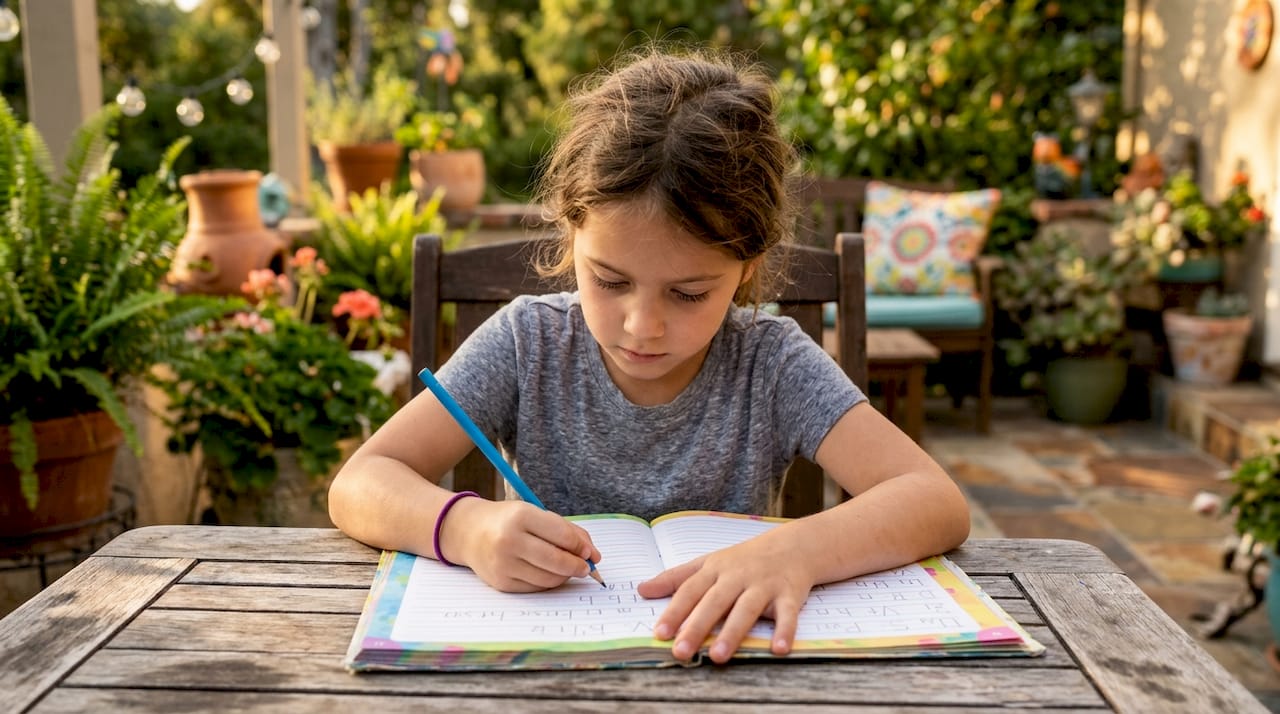
- Posture: Sit with feet flat on the floor, back straight, and forearms resting on the desk. Children who slouch put strain on their neck and shoulders, which shows up as uneven, shaky letters.
- Paper angle: Tilt the paper slightly, about 20–45 degrees, to match the natural arc of the writing arm. Right-handed writers tilt the top of the page to the left; left-handed writers tilt it to the right.
- Pencil grip: The tripod grip, where the pencil rests between the thumb and index finger with the middle finger supporting underneath, gives the most control. A grip that is too tight causes hand fatigue within minutes.
- Practice: Short, consistent sessions build muscle memory faster than occasional long ones. Fifteen to twenty minutes daily is the target for children aged 3–6.
Finger-only writing leads to fatigue and uneven letter shapes. Engaging the forearm and shoulder muscles produces longer, smoother strokes. Teach children to move their whole arm, not just their fingers, when forming letters.
Pro Tip: Use the non-writing hand as an “anchor” by pressing it flat on the paper. Stabilizing the page this way prevents slipping and gives the writing hand consistent pressure and fluid movement.
How does daily practice shape a child’s writing development?
Consistent daily practice of 15–20 minutes leads to visible legibility improvements within 3–4 weeks, with lasting changes forming within 1–3 months. Short, focused sessions build muscle memory far more effectively than infrequent long ones. This mirrors how musicians practice scales: repetition of small units creates automatic, fluid movement over time.
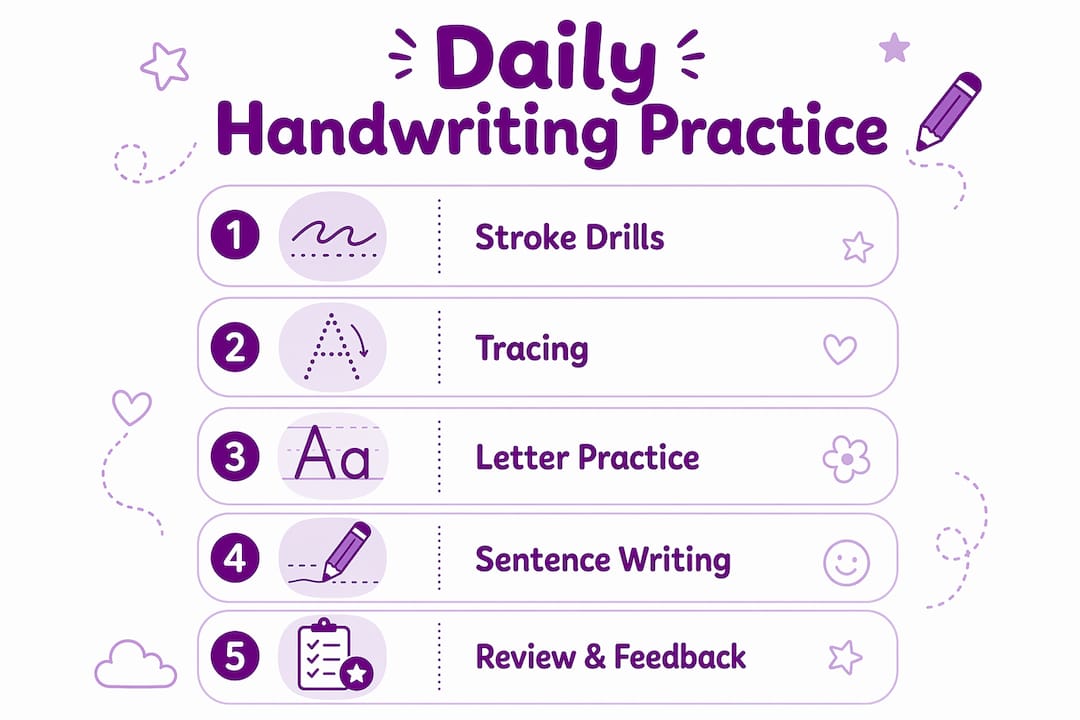
The sequence of exercises matters. Start with the simplest strokes and build toward full letters:
- Ovals and circles: These train the curved motion used in letters like “a,” “o,” “d,” and “g.”
- Vertical and horizontal lines: These build control for letters like “l,” “t,” “i,” and “H.”
- Diagonal strokes: These prepare children for letters like “v,” “w,” “k,” and “x.”
- Loop patterns: These develop the rhythm needed for cursive handwriting practice and connected scripts.
- Letter drills: Repeat individual letters in rows, focusing on consistent size and spacing.
- Word-level practice: Move to short words only after individual letters are consistent.
Mastering basic strokes like ovals, lines, and loops builds the rhythm and control that underpin elegant writing across all scripts. Think of it as the foundation before the house.
Tracing is the right starting point for young children and bilingual learners. It lets children feel the correct stroke path before attempting it independently. Littlepumpkins builds this principle directly into its reusable magic ink books, where children trace letters in English, Hindi, and Punjabi before writing on their own. You can read more about why tracing precedes independent letter formation and why it works so well for early learners.
| Practice type | Frequency | Expected benefit |
|---|---|---|
| Stroke drills (ovals, lines) | Daily, 5 minutes | Builds rhythm and arm control |
| Letter repetition | Daily, 10 minutes | Improves consistency and spacing |
| Tracing exercises | Daily, 5–10 minutes | Reinforces correct stroke direction |
| Free writing | 3–4 times per week | Transfers skills to real writing tasks |
What should parents know when teaching bilingual or heritage language learners?
Teaching a child to write in two scripts at once is genuinely more complex than teaching one. Each script has its own stroke direction, letter shapes, and rhythm. Punjabi’s Gurmukhi script flows differently from the Latin alphabet, and Hindi’s Devanagari script uses a top horizontal bar that has no equivalent in English. Children need explicit instruction in each script’s unique patterns, not just exposure.
Several approaches work well for bilingual learners:
- Multisensory tracing: Let children trace letters in sand, on textured paper, or with their finger in the air before using a pencil. This builds a physical memory of the stroke path.
- Rhythm-based practice: Chant the stroke sequence aloud while writing. “Down, curve, up” for a letter “a” gives children a verbal anchor for the physical movement.
- Script-specific stroke drills: Basic strokes like ovals and lines are foundational across all writing systems. Start there before introducing script-specific letters.
- Consistent tools: Use the same pencil grip and posture for both scripts. Switching tools or positions between languages adds unnecessary confusion.
“Children who maintain their heritage language writing skills show stronger overall literacy outcomes. The cognitive work of managing two scripts builds mental flexibility that transfers to reading, spelling, and problem-solving across both languages.”
Occupational therapists and calligraphy educators both recommend starting with foundational strokes before introducing full letters in a new script. This approach respects how the brain learns motor skills: simple patterns first, complexity later. Littlepumpkins’ tracing books for heritage scripts apply exactly this method, giving children a structured path into each language’s writing system.
What common mistakes slow down writing improvement?
The most common obstacle to improving penmanship is a grip that is too tight. Children who squeeze the pencil hard tire within minutes and produce shaky, inconsistent letters. The fix is simple: check that there is a small gap between the pencil and the palm, and that the fingers are relaxed.
Watch for these patterns that hold children back:
- Finger-only movement: Writing with only the fingers, not the arm, creates short, cramped strokes. Engaging larger arm muscles produces smoother, more consistent letterforms.
- Poor posture: Slouching compresses the writing arm and limits range of motion. A child who hunches over the page will fatigue faster and write less neatly.
- Infrequent practice: Skipping days breaks the muscle memory loop. Daily short sessions beat weekly long ones every time.
- Overly long sessions: Practicing for 45 minutes straight causes fatigue and reinforces bad habits. Stop at 20 minutes while the child is still engaged.
- Emotional pressure: Feeling rushed or frustrated reflects directly in penmanship quality. A child who feels stressed will write worse, not better.
Pro Tip: Before a practice session, have your child shake out their hands and take three slow breaths. This simple reset reduces tension in the grip and produces noticeably cleaner letters from the first stroke.
The emotional dimension of writing practice is underrated. Children who feel safe to make mistakes practice more freely and improve faster. Praise the process, not the result. “I love how you kept your letters the same size” works better than “That looks messy.”
Key Takeaways
Strong penmanship develops through consistent technique, daily short practice, and script-specific instruction tailored to each child’s language background.
| Point | Details |
|---|---|
| Use the 4 Ps framework | Posture, Paper angle, Pencil grip, and Practice form the foundation of effective writing instruction. |
| Practice daily in short sessions | 15–20 minutes each day builds muscle memory faster than occasional long sessions. |
| Start with tracing | Tracing correct stroke paths prepares children for independent letter formation in any script. |
| Teach each script separately | Bilingual learners need explicit instruction in each writing system’s unique stroke patterns and directions. |
| Manage emotional state | A calm, low-pressure environment produces better writing and faster improvement in children. |
Why I think we underestimate handwriting in multilingual homes
Bobby here. I have spent years watching children learn to write in two languages at once, and the pattern I see most often surprises parents: the children who struggle most are not the ones with poor fine motor skills. They are the ones whose adults gave up on the heritage script too early.
Neuroplasticity research confirms that the brain can retrain and improve writing at any age. That means it is never too late to start, and it is never too early either. A three-year-old tracing Gurmukhi letters is not doing something exotic. She is building neural pathways that will make her a stronger reader, writer, and thinker in both languages.
The advice I give every parent is this: treat the heritage script as equally important as English, not as a weekend bonus activity. Children absorb your priorities. If you practice Hindi or Punjabi letters with the same calm consistency you bring to English alphabet drills, your child will too. The writing developmental milestones for bilingual children are not behind those of monolingual peers. They are simply richer.
Patience matters more than any technique. I have seen children go from refusing to hold a pencil to filling pages of neat letters in under two months. The turning point is almost always the same: a parent who stopped correcting and started celebrating.
— Bobby
Littlepumpkins writing books for your child’s practice
Littlepumpkins designs writing and tracing books specifically for children aged 3–6, with reusable magic ink technology that makes practice feel like play. Each book guides children through correct stroke formation one letter at a time, in English, Hindi, and Punjabi.

The writing books for kids collection covers tracing and independent letter practice across multiple scripts, giving bilingual families one trusted resource for all their children’s writing needs. For families focused on English literacy, the English tracing book builds alphabet recognition and letter formation from the ground up. For heritage language practice, the Hindi tracing book applies the same multisensory approach to Devanagari script. Every book is designed to make daily practice something your child actually looks forward to.
FAQ
What is the best age to start teaching handwriting?
Children typically develop the fine motor readiness for letter formation between ages 3 and 5. Starting with tracing exercises at age 3 builds the muscle control needed for independent writing by kindergarten.
How long should a child practice writing each day?
Daily sessions of 15–20 minutes produce visible improvement in legibility within 3–4 weeks. Shorter, consistent practice outperforms longer, infrequent sessions for motor skill development.
Can adults improve their handwriting too?
Yes. Neuroplasticity allows people of all ages to retrain and improve their penmanship. The same principles of daily short practice and correct grip apply to adults as they do to children.
How do I teach a child to write in two scripts at once?
Teach each script separately using its own stroke drills before introducing full letters. Multisensory tracing, rhythm-based chanting of stroke sequences, and consistent posture across both scripts help children manage two writing systems without confusion.
Why does my child’s handwriting look worse when they are tired or upset?
Emotional state directly affects penmanship quality. Stress and fatigue increase grip tension and reduce arm control, producing shakier, less consistent letters. A short rest or calming routine before practice sessions makes a measurable difference.
Recommended
- Writing Developmental Milestones for Kids: A Parent’s Guide – Little Pumpkins
- How Handwriting Workbooks Improve Fine Motor Skills in Kids | Parent Guide – Little Pumpkins
- How Children Learn to Write for Beginners: A Parent’s Guide – Little Pumpkins
- How Children Develop Writing Muscle Memory – Little Pumpkins