


How to Choose First Writing Tools for Toddlers
The best first writing tools for toddlers are not pencils. They are sensory materials, egg-shaped crayons, and broken crayon pieces that build hand strength and proper grip before formal writing ever begins. When you choose first writing tools for toddlers, the goal is muscle development first and mark-making second. Early childhood education guidance from the Raising Children Network confirms that scribbling starts around age 2, and the tools you offer at each stage either support or slow that natural progression. Getting this right from the start gives your child a real advantage in literacy, confidence, and fine motor control.
What developmental skills should toddlers build before writing?
Pre-writing is about 80% muscle development and only 20% tool handling. That ratio matters because most parents focus on the tool and skip the preparation entirely.
Muscle-building activities like squeezing, pinching, and rolling playdough provide the resistance training toddlers need before any writing tool makes sense. Threading beads, tearing paper, and pinch-grip exercises all build the finger strength that will eventually control a crayon or pencil. Without this foundation, even the best tool will feel awkward and frustrating for your child.
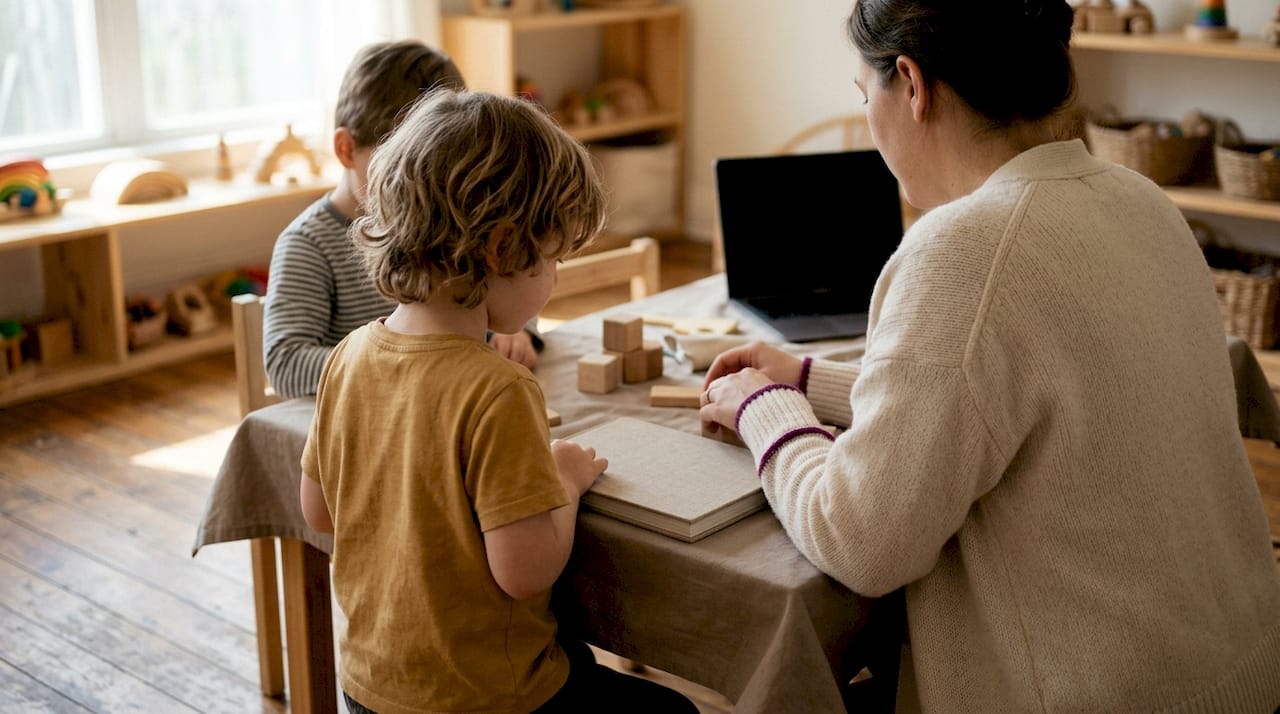
For children under age 2, sensory exploration is the priority. Let them press fingers into wet sand, foam, or finger paint. These activities build hand awareness and muscle memory without any formal instruction.
Once your toddler is around 2 to 3 years old, posture starts to matter. Vertical writing surfaces like easels promote wrist extension and shoulder stability, both of which are critical for developing controlled, downward strokes later. A flat table does not offer this benefit. Propping a clipboard against a wall or using a tabletop easel costs almost nothing and makes a real difference.
Key pre-writing skills to build before introducing tools:
- Hand strength: Playdough, squeezing sponges, and tearing activities
- Finger coordination: Threading, pegboards, and pinch-grip exercises
- Hand-eye coordination: Stacking blocks, pouring, and simple puzzles
- Sensory awareness: Finger painting, sand trays, and foam writing surfaces
- Shoulder stability: Vertical surface activities like easel drawing or wall painting
Pro Tip: Place a sheet of paper on a low wall and let your toddler draw standing up. This vertical position builds the shoulder and wrist strength that flat table drawing simply cannot.
Which writing tools are best for toddlers at each stage?
The right tool depends entirely on where your child is developmentally, not on their age alone. Here is the progression that early childhood experts recommend:
-
Finger mark-making (ages 0–2). Start with fingers in wet sand, shaving foam, or washable finger paint. No tool required. This builds sensory awareness and the concept that marks communicate something.
-
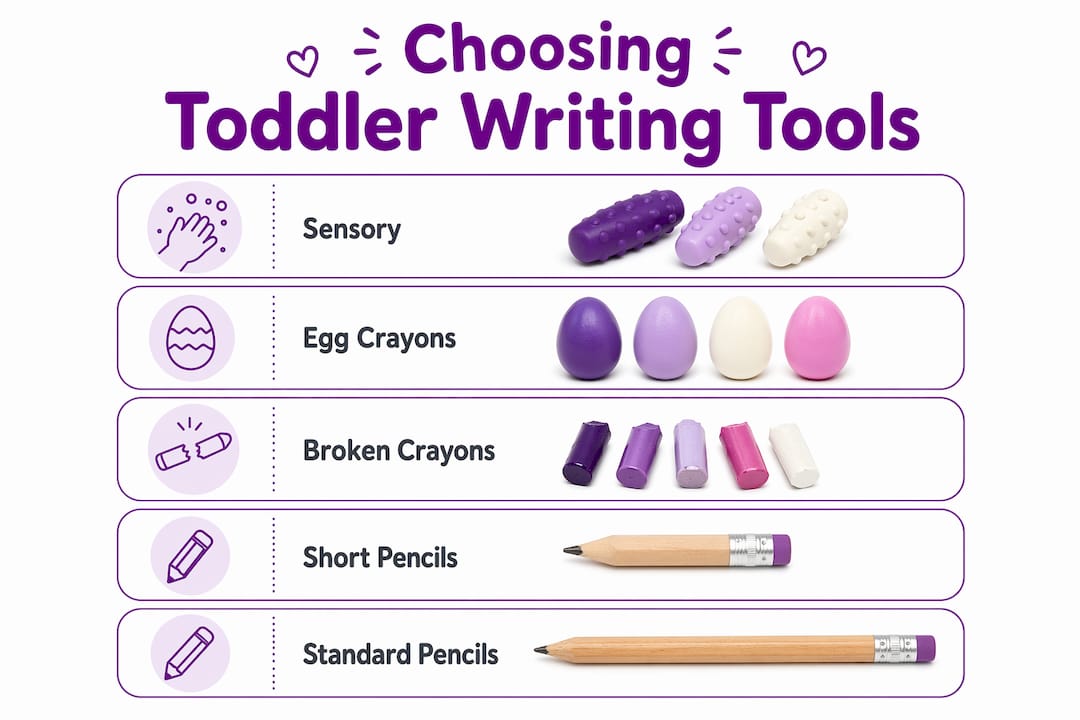
Egg-shaped crayons (around age 2). These fit naturally in a whole-hand grasp, which is exactly where toddlers start. They are chunky enough to hold without frustration and sturdy enough to survive enthusiastic pressing.
-
Broken crayon pieces (ages 2–3). This is the step most parents skip, and it is one of the most important. Small broken crayons physically prevent the immature fist grasp because there is nothing long enough to wrap a whole hand around. The child naturally uses three fingers, which is exactly the tripod grip you want to develop.
-
Short, triangular pencils (ages 3–4+). Introduce these only after your child shows real finger strength and a consistent tripod grip. Short pencils reinforce the same grip that broken crayons started building.
-
Standard pencils and markers (ages 4–5+). These come last. Long, cylindrical markers encourage a whole-hand fist grasp and do not require any finger muscle exertion. They feel easy, which is exactly the problem. Easy glide delays grip development.
| Tool type | Best for | What to watch for |
|---|---|---|
| Egg-shaped crayons | Whole-hand grasp, ages 2+ | Good starting point, not a long-term tool |
| Broken crayon pieces | Tripod grip development | Stop when mouthing behavior ends |
| Short triangular pencils | Finger strength and control | Introduce only with consistent grip |
| Long markers | Not recommended early | Reinforces fist grasp, delays development |
Pro Tip: Break your regular crayons in half on purpose. You do not need to buy special products. A broken crayon is one of the most effective grip-training tools available.
How to choose eco-friendly and durable writing tools
Sustainability in writing tools means durability first. A product labeled “eco-friendly” but made to last only a few weeks creates more waste than a well-made wooden tool that lasts years. Durability reduces landfill impact far more reliably than material origin alone.
When selecting writing materials for your toddler, look for these qualities:
- FSC-certified wood products: Wooden easels, blocks, and manipulatives sourced from certified forests are genuinely sustainable and built to last multiple years.
- Refillable markers: Some washable marker sets allow ink cartridge replacement, cutting down on plastic waste significantly.
- Recycled paper products: Drawing paper made from post-consumer recycled content reduces resource use without sacrificing quality.
- Beeswax or natural wax crayons: These avoid petroleum-based paraffin and tend to be more durable than standard crayons.
A wooden easel that lasts several years is more sustainable than a dozen plastic alternatives that crack and end up in landfill. The same logic applies to tracing books with reusable pages. Tools that children can use again and again reduce both cost and waste over time.
Balancing eco-consciousness with developmental needs is straightforward. Choose the most durable version of the developmentally appropriate tool. If your child is at the broken-crayon stage, buy quality beeswax crayons and break them yourself rather than buying cheap disposable sets. You get the developmental benefit and the environmental benefit at the same time.
For parents interested in reusable writing tools for toddlers, magic ink tracing books offer a particularly practical option. Children trace letters and the page resets, eliminating paper waste entirely while giving toddlers repeated practice on the same surface.
What are the best ways to encourage toddler writing confidence?
Motivation drives practice, and practice builds skill. The single most effective thing you can do is let your toddler see you write with purpose. Seeing parents write lists or notes helps toddlers understand that writing communicates something real. That understanding motivates them to pick up a crayon and do the same.
Practical strategies that work:
- Model writing daily. Write a grocery list, a birthday card, or a note and narrate what you are doing. “I’m writing down what we need from the store.” Your child watches and connects writing to real life.
- Offer varied surfaces. Chalk on a sidewalk, a finger in a sand tray, a crayon on textured paper. Different surfaces build different muscle responses and keep the activity fresh.
- Use water drawing. A paintbrush dipped in water on dark construction paper gives toddlers a low-mess, endlessly reusable writing surface. It is also completely eco-friendly.
- Try tracing activities. Tracing letters, shapes, or simple patterns gives toddlers a guided path to follow, which builds confidence faster than blank-page drawing.
- Celebrate marks, not accuracy. Praise the act of making marks, not the quality of the result. “You made so many lines!” works better than “That doesn’t look like an A yet.”
For bilingual or multilingual families, cultural language tools add a meaningful layer. Tracing letters in Punjabi, Hindi, or another heritage language alongside English gives toddlers a connection to their roots while building the same fine motor skills. Littlepumpkins designs its magic ink tracing books specifically for this purpose, letting children practice Hindi and English letters on reusable pages with engaging illustrations.
Pro Tip: Set up a “writing corner” with a small basket of crayons, a sand tray, and a few sheets of paper. When your toddler sees a dedicated space for writing, they treat it as an invitation rather than a chore.
Understanding why preschool writing activities matter goes beyond motor skills. Early writing builds self-expression, attention span, and the confidence to try new things.
Key Takeaways
The most effective approach to choosing first writing tools for toddlers is to follow the developmental progression from sensory mark-making to egg crayons to broken crayons to short pencils, while prioritizing muscle-building activities at every stage.
| Point | Details |
|---|---|
| Start with sensory tools | Finger painting and sand trays build hand awareness before any crayon is introduced. |
| Use broken crayons strategically | Small crayon pieces naturally develop tripod grip without any correction needed. |
| Avoid long markers early | Cylindrical markers reinforce fist grasp and delay the finger strength toddlers need. |
| Choose durable over disposable | A long-lasting wooden easel reduces waste more than any eco-labeled plastic product. |
| Model writing with purpose | Toddlers engage with writing when they see it used meaningfully by the adults around them. |
What I’ve learned from watching parents rush the process
Most parents I talk to make the same mistake. They hand their two-year-old a standard pencil because it looks like “real writing,” and then wonder why their child loses interest after thirty seconds. The pencil is too long, too light, and requires finger strength the child simply does not have yet. The result is frustration on both sides.
The broken crayon trick genuinely surprises people when they first hear it. It sounds too simple to matter. But the physics are real. A two-inch crayon piece cannot be gripped with a fist. The child’s hand adapts automatically. That is the kind of low-effort, high-impact adjustment that makes a real difference without any formal instruction.
Patience with developmental timing is not passive. It means actively building the prerequisites, the playdough, the threading, the vertical surface drawing, so that when the right tool arrives, your child’s hand is ready for it. Rushing to pencils skips the foundation and often creates habits that take months to undo.
Sustainability is worth thinking about early too. The tools you buy now set a pattern. Choosing durable, reusable materials teaches your child something beyond writing. It teaches them that the things we use are worth caring for. That lesson starts with a good crayon and a well-made book.
— Bobby
Littlepumpkins writing books for toddler literacy
Littlepumpkins creates writing books designed specifically for the ages when early literacy begins to take shape. Their tracing and handwriting practice books use reusable magic ink technology, so toddlers can trace letters again and again on the same page without wasting paper.
For families raising bilingual children, the English tracing book and Hindi tracing options let toddlers practice both languages with the same engaging, mess-friendly format. The illustrations are warm and inviting, and the reusable design makes these books genuinely eco-friendly. Parents report that children ask to practice writing rather than being prompted. That kind of enthusiasm is exactly what early literacy needs to grow.
FAQ
What are the best first writing tools for a 2-year-old?
Egg-shaped crayons and finger painting materials are the best starting points for a 2-year-old. These tools match the whole-hand grasp that toddlers naturally use at this stage.
When should toddlers start using pencils?
Toddlers should start using short pencils only after they show consistent tripod grip and adequate finger strength, typically around ages 3–4. Introducing pencils too early can reinforce poor grip habits.
Why are broken crayons better than whole crayons for toddlers?
Broken crayon pieces are too small for a fist grasp, which naturally encourages the tripod grip toddlers need for writing. This happens without any correction from a parent or teacher.
What makes a writing tool eco-friendly for toddlers?
Durability is the defining factor. A durable wooden tool that lasts years creates less waste than a disposable item made from recycled materials. Reusable tracing books and FSC-certified wooden manipulatives are strong choices.
How can I help my toddler enjoy writing practice?
Model writing with purpose in front of your child and offer varied surfaces like chalk, sand trays, and textured paper. Praising the act of making marks rather than the result builds confidence and keeps toddlers motivated to practice.
Recommended
- How to Recognize Writing Readiness in Toddlers – Little Pumpkins
- Writing Developmental Milestones for Kids: A Parent’s Guide – Little Pumpkins
- How Children Learn to Write for Beginners: A Parent’s Guide – Little Pumpkins
- How to Make Writing Practice Fun for Kids Aged 3–6: Daily Tips & Activities – Little Pumpkins