


How to Recognize Writing Readiness in Toddlers
Writing readiness in toddlers is defined as the point when a child begins making meaningful marks and can physically control writing tools well enough to express early ideas. This is not about forming perfect letters. It is about recognizing when your toddler’s brain and hands are ready to work together. The formal term used in early childhood education is emergent writing, and it covers everything from scribbling with crayons to assigning meaning to a squiggle. Knowing how to recognize writing readiness in toddlers helps you support your child at exactly the right moment, without pushing too hard or holding back too long.
What are the key physical signs of writing readiness in toddlers?
The most visible signs of writing readiness are physical. They show up in how your toddler holds a crayon, how long they stay focused, and how confidently they move a tool across paper.
The clearest physical milestone is grasp development. Children progress from palmar grasp to a tripod grasp as their fine motor skills mature through toddlerhood. A palmar grasp means your child wraps their whole fist around a crayon. A tripod grasp means they hold it between thumb, index, and middle finger, the grip used for writing. You do not need to force this transition. It happens naturally as hand strength builds.
Here are the key physical signs to watch for:
- Palmar to tripod grasp shift. Your toddler moves from gripping crayons with their whole hand to using their fingers.
- Controlled tool movement. They can drag a crayon or marker in a deliberate direction rather than just stabbing at the page.
- Pincer grip in play. Picking up small objects like raisins or puzzle pieces shows the finger strength needed for writing tools.
- Wrist rotation. Turning a doorknob, unscrewing a lid, or stirring with a spoon all build the wrist control writing requires.
- Sustained tool use. They return to drawing or coloring rather than dropping the tool after a few seconds.
Hand strength is often overlooked. Activities like tearing paper, squeezing playdough, or using child-safe scissors all build the small muscles that eventually control a pencil. These are not just fun activities. They are direct preparation for writing.
Pro Tip: Watch your toddler during unstructured play. If they spontaneously reach for crayons, chalk, or sticks to make marks on surfaces, that is one of the clearest early signs of writing readiness you will see.
How does symbolic thinking connect to writing readiness?
Physical control is only half the picture. The cognitive side of writing readiness is called representational thinking, and it is just as important as grip development.
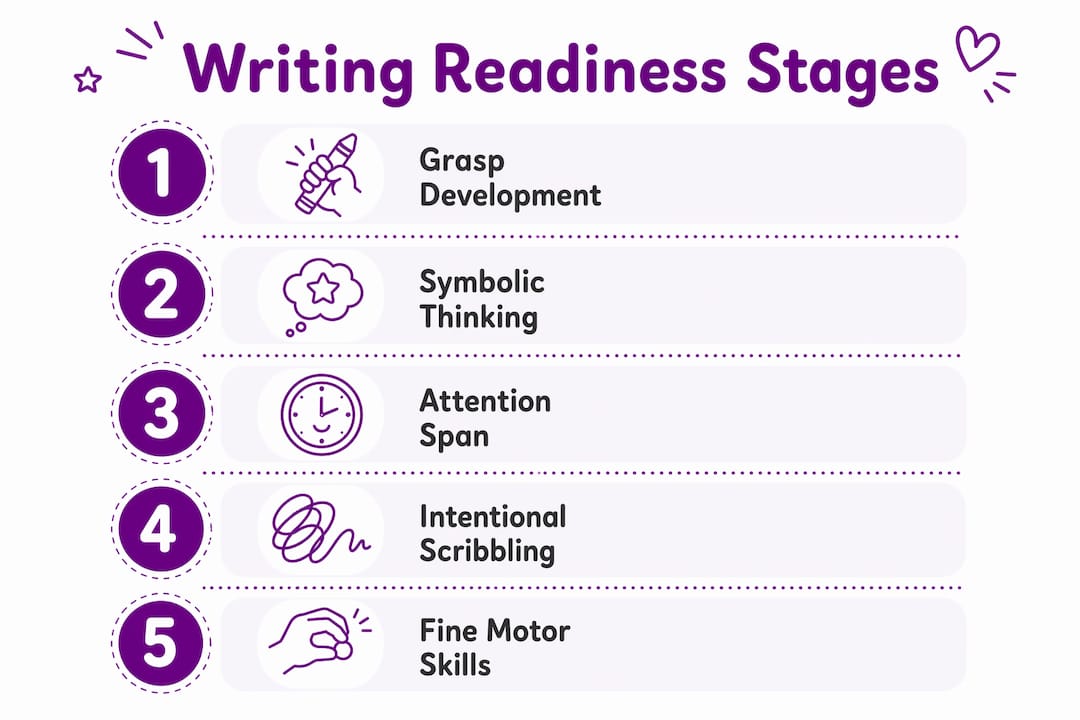
Early mark making shows representational thinking when toddlers assign meaning to their scribbles, understanding that marks can stand for real objects or ideas. This is the mental leap that makes writing possible. Before a child can write the word “dog,” they need to understand that a mark on paper can mean dog.
Here is how this development typically unfolds:
- Random scribbling (around 12 to 18 months). Your toddler makes marks with no stated intention. The movement itself is the point.
- Controlled scribbling (around 18 to 24 months). Marks become more deliberate. Your child repeats shapes or lines on purpose.
- Named scribbles (around 2 to 3 years). Your toddler finishes drawing and announces, “That’s a dog.” The drawing may look like a spiral, but the meaning is real to them.
- Pre-schematic drawing (around 3 to 4 years). Recognizable shapes appear, like circles for faces or lines for legs.
The named scribble stage is the critical signal. A toddler may understand that marks have meaning even when their hand control is still developing. This means a child can be cognitively ready for writing before they are physically ready, and vice versa. Assessing both separately gives you a much clearer picture of where your child actually stands.
Pro Tip: Instead of asking “What is that?” after your toddler draws, ask “Tell me about your drawing.” The first question implies the drawing should look like something. The second invites storytelling and honors the meaning your child has already created.
How do attention and engagement signal writing readiness?
A toddler who is ready to write will show it through how long they stay focused on a task. The ability to sit for 5 to 10 minutes engaging with a single activity is a recognized signal of writing readiness. This matters because writing requires sustained attention, not just a burst of energy.
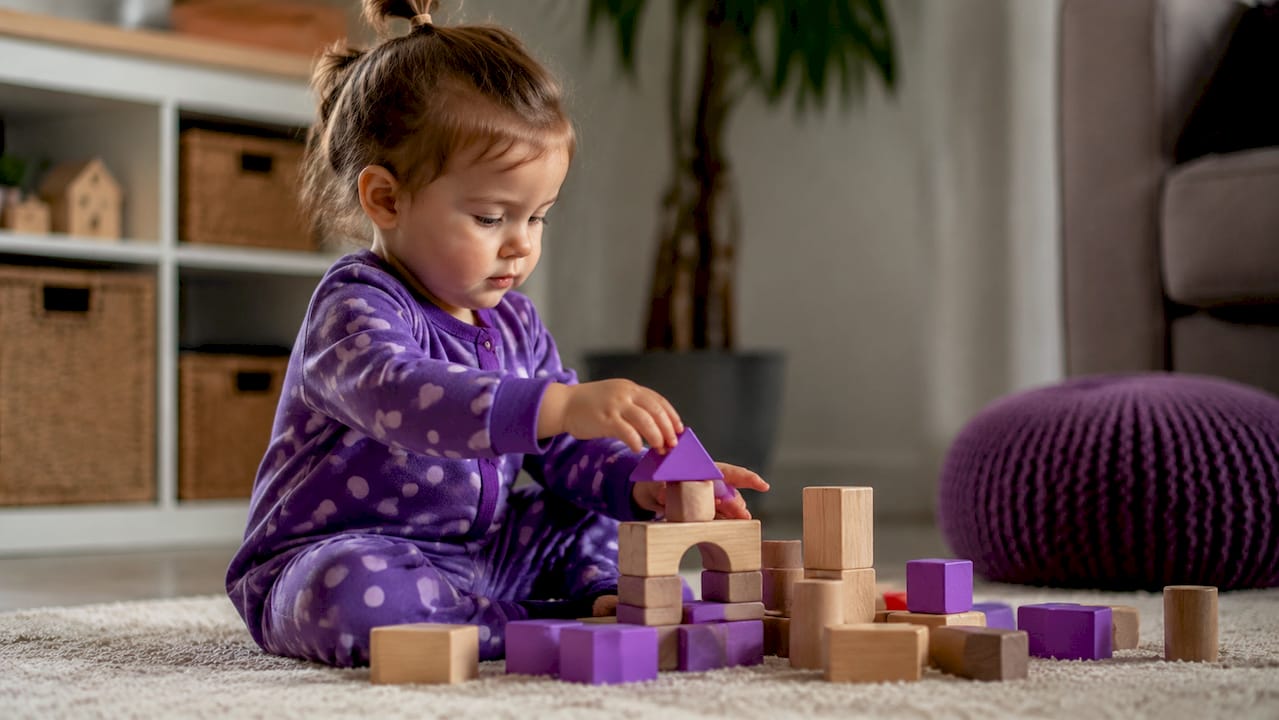
Task adherence varies by prompt more than by age alone as a readiness marker, which means the activity you offer matters as much as your child’s age. A toddler who loses interest in flashcards in 30 seconds may happily color for 10 minutes. That engagement tells you something real.
Watch for these engagement-based signs:
- Returning to an activity. Your toddler walks away and comes back to the same drawing or puzzle without being prompted.
- Requesting materials. They ask for crayons, paper, or chalk on their own.
- Frustration when interrupted. They protest when you take away a drawing tool mid-activity. This shows investment, not bad behavior.
- Copying behavior. They watch you write a grocery list or sign a card and immediately want to “write” too.
Coloring books, simple puzzles, and sticker activities are excellent tools for observing focus duration in a low-pressure setting. You are not testing your child. You are watching for natural signals that their attention is ready to support writing practice.
What are practical ways to support toddler writing readiness?
The best thing you can do right now is create an environment where mark making feels natural and fun. Early writing is best encouraged through free drawing and messy play, not premature letter tracing. Pushing formal writing too early can create tense grips and frustration that set children back rather than move them forward.
Here is what actually works:
- Offer big tools first. Chunky crayons, fat markers, and sidewalk chalk are easier to grip and build confidence faster than thin pencils.
- Make surfaces interesting. Let your toddler draw on large paper taped to the floor, on a chalkboard, or even in a tray of sand or shaving cream.
- Encourage messy play. Finger painting, playdough, and water play all strengthen the same muscles used in writing.
- Display their artwork. Hanging a toddler’s scribbles on the fridge sends a clear message: what you make matters. This builds motivation.
- Introduce tracing gently. When your child shows interest in letters, tracing activities offer a guided path without the pressure of freehand writing.
Emergent writing behaviors like scribbling and messy play build communication and literacy confidence before formal instruction begins. Think of every scribble as a sentence your child is learning to say with their hands.
Pro Tip: Large arm movements build the shoulder and arm strength that eventually supports fine motor control. Let your toddler paint on an easel, draw on a vertical surface, or trace shapes in the air. These big movements are writing readiness activities hiding in plain sight.
How does writing readiness fit into broader school readiness?
Writing readiness does not exist in isolation. It is one piece of a larger picture that includes language development, social skills, and physical coordination. School readiness is holistic, and the American Academy of Pediatrics recommends multi-domain observations that include physical tool use, communication, and social behavior together.
The table below shows how writing readiness connects to other key school readiness areas:
| Readiness area | What it looks like in toddlers |
|---|---|
| Fine motor skills | Holds crayons, turns pages, uses scissors with support |
| Communication | Names objects, follows two-step instructions, tells simple stories |
| Social skills | Takes turns, follows group routines, manages short separations |
| Print awareness | Points to words in books, recognizes their own name in print |
| Attention and focus | Completes a simple task without constant redirection |
Print awareness deserves special attention. A toddler who notices letters on cereal boxes, points to their name on a drawing, or asks “What does that say?” is building the cognitive foundation that writing depends on. Early mark making supports abstract reasoning and literacy in ways that extend far beyond putting pencil to paper.
Readiness screening should be supportive, not a gate that children must pass. Your role is to observe, encourage, and meet your toddler where they are. Confidence and motivation built in these early years carry forward into kindergarten and beyond. Language development in babies and toddlers feeds directly into writing readiness, making early conversation and storytelling just as valuable as any drawing activity.
Key takeaways
Writing readiness in toddlers is best recognized by watching for a combination of grasp development, symbolic thinking, sustained attention, and spontaneous mark making rather than any single milestone.
| Point | Details |
|---|---|
| Grasp development matters | Watch for the shift from palmar to tripod grip as a clear physical readiness signal. |
| Symbolic thinking comes first | Named scribbles show cognitive readiness even before hand control is fully developed. |
| Engagement duration is a signal | A toddler who focuses on drawing for 5 to 10 minutes is showing real writing readiness. |
| Messy play builds writing muscles | Playdough, finger painting, and large arm movements strengthen the hands needed for writing. |
| School readiness is multi-domain | Writing readiness connects to communication, print awareness, and social skills together. |
What most parents miss about early mark making
I have spent years watching toddlers pick up crayons for the first time, and the moment that always surprises parents is the named scribble. A child holds up a page of overlapping loops and says, “That’s Grandma.” The parent smiles politely, unsure what to do with that information. What they are actually witnessing is one of the most significant cognitive leaps in early childhood. Their toddler just proved they understand that marks carry meaning. That is the entire premise of written language.
Most parents focus on whether the marks look like anything. The more useful question is whether the child believes the marks mean something. Those are two very different things, and the second one matters far more at age two or three.
The other thing I see parents get wrong is the rush to tracing. Tracing has real value, but only once a child has the hand strength and focus to do it without tension. Physical and cognitive skills mature in tandem, and expecting neat letters too soon creates frustration that can make a child avoid writing altogether. The children who arrive at kindergarten genuinely excited to write are almost always the ones whose early mark making was celebrated rather than corrected.
Give your toddler big paper, chunky crayons, and zero expectations about what the result should look like. That is not lowering the bar. That is building the foundation.
— Bobby
Start your toddler’s writing adventure with Littlepumpkins

When your toddler is showing signs of writing readiness, having the right tools makes all the difference. Littlepumpkins creates reusable magic ink tracing and handwriting books designed for children aged 3 to 6, covering English, Hindi, Punjabi, and more. The magic ink technology means your child can trace letters again and again without wasting paper, keeping practice low-pressure and genuinely fun. Each book pairs guided letter tracing with engaging illustrations that hold a toddler’s attention far longer than a blank worksheet. Whether your family speaks one language or several, Littlepumpkins offers drawing books for toddlers and script-specific tracing books that grow with your child’s readiness.
FAQ
What age do toddlers typically show writing readiness?
Most toddlers begin showing early signs of writing readiness between 18 months and 3 years. Named scribbles and intentional mark making usually appear around age 2 to 3, while tripod grasp development typically follows between ages 3 and 4.
What is the difference between emergent writing and formal writing?
Emergent writing is the stage where toddlers make meaningful marks, scribble with intention, and assign symbolic meaning to their drawings. Formal writing involves recognizable letters and words and comes later, typically in preschool and kindergarten.
Can a toddler be cognitively ready for writing but not physically ready?
Yes. A toddler may understand that marks carry meaning well before their hand control is developed enough to form letters. Assessing symbolic thinking and fine motor skills separately gives a more accurate picture of where your child stands.
Should I use tracing books with my toddler?
Tracing books work well once your toddler shows interest in letters and has enough hand strength to hold a tool without tension. Introducing tracing too early can create tight grips and frustration. Start with free drawing and messy play first, then introduce gentle tracing when your child is ready.
How can I tell if my toddler is engaged enough for writing activities?
A toddler who returns to a drawing activity on their own, requests crayons or paper, or protests when interrupted is showing strong engagement. Focus on a single task for 5 to 10 minutes is a practical benchmark for writing readiness in this age group.