

Start Early Literacy Activities at Age 3 Today
Emergent literacy is defined as the foundational set of skills children develop before formal reading begins, and age 3 is the ideal window to start building them. When you start early literacy activities at age 3, you are not teaching your child to decode words. You are cultivating print awareness and phonological awareness, the two core building blocks that reading researchers at the Iowa Reading Research Center identify as critical for future reading success. The goal at this stage is joyful, brief, and consistent. Five to ten minutes of daily play-based practice beats a single long session every time.
What early literacy skills to focus on at age 3
The two skills that matter most right now are print awareness and phonological awareness. These are not the same thing, and understanding the difference helps you choose the right activities.
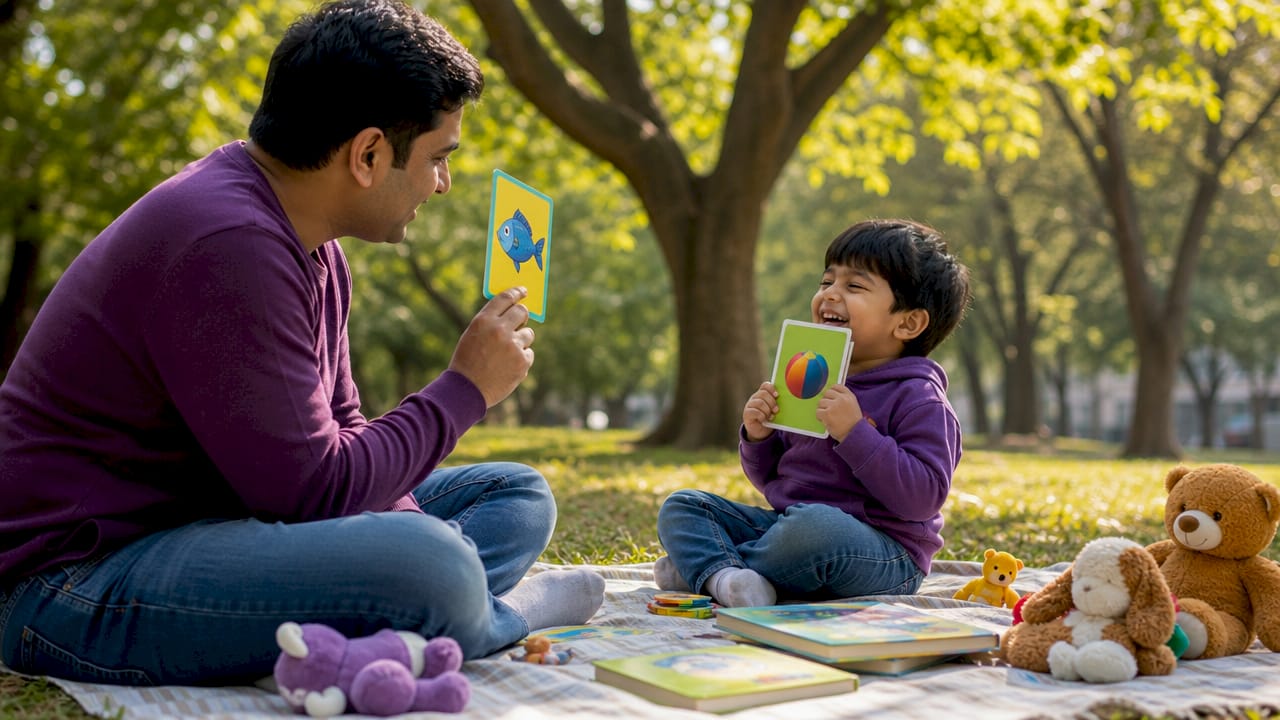
Print awareness is the understanding that written marks carry meaning. A 3-year-old with developing print awareness will hold a book correctly, turn pages in the right direction, point to words on a cereal box, and notice that the golden arches spell something. This is a behavioral skill set built through regular routines, not a cognitive leap that happens overnight.
Phonological awareness is the ability to hear and play with the sounds in spoken language. It includes:
- Recognizing rhymes (“cat” and “hat” sound alike)
- Clapping syllables in words (“el-e-phant” has three beats)
- Identifying the first sound in a word (“ball starts with /b/”)
- Listening carefully to sound patterns in songs and stories
Neither of these skills requires your child to read a single word. They are entirely sound-based and book-handling-based at age 3. Letter-sound correspondence, where a child connects the letter “B” to the sound /b/, comes later. You can introduce it playfully, but do not make it the centerpiece of your sessions yet. The Spark Early Literacy Hub from the Iowa Reading Research Center offers free letter-sound card games designed specifically for this gradual, deliberate exposure. Exposure alone is not enough. Children need deliberate opportunities to notice sounds and connect them to letters, and that is exactly what structured play provides.
How to make early literacy activities genuinely fun for your 3-year-old
Play-based learning is not a compromise. It is the method. Playful phonics activities built around movement, stories, and sensory input produce better motivation and stronger foundational skills than worksheets at this age. Here are specific activities that work beautifully for 3-year-olds.
-
First-sound treasure dig. Fill a shallow tray with dry rice. Bury five or six small objects, like a ball, a button, a bear, and a block. Ask your child to dig for things that start with the /b/ sound. The sensory rice tray anchors phonemic awareness with a physical, memorable experience. Children who use their hands while learning retain the concept longer.
-
Shared reading with finger tracking. Read a favorite picture book together and run your finger slowly under the words as you read. This is not about your child reading. It teaches them that print moves left to right, that spaces separate words, and that the marks on the page match the sounds coming out of your mouth. Point to a familiar word like “the” repeatedly across pages and watch recognition build naturally.
-
Letter scavenger hunt. Write one letter on a sticky note and challenge your child to find that letter on cereal boxes, food packages, and signs around the house. Movement-based letter games keep preschoolers engaged and improve letter knowledge retention far better than sitting at a table with a pencil.
-
Rhyming song games. Sing nursery rhymes and pause before the rhyming word, letting your child fill it in. “Jack and Jill went up the ___.” This builds phonological prediction, a skill directly linked to reading fluency later on.
-
Label the house. Tape simple word labels to objects around your home: “door,” “chair,” “lamp.” Your child does not need to read these labels. Seeing print in context teaches them that everything has a written name, which is the core of print awareness.
Pro Tip: Pick one activity per day and repeat it for three or four days before switching. Repetition at this age is not boring. It is how the brain locks in a new skill.
How to build a daily literacy routine that actually sticks
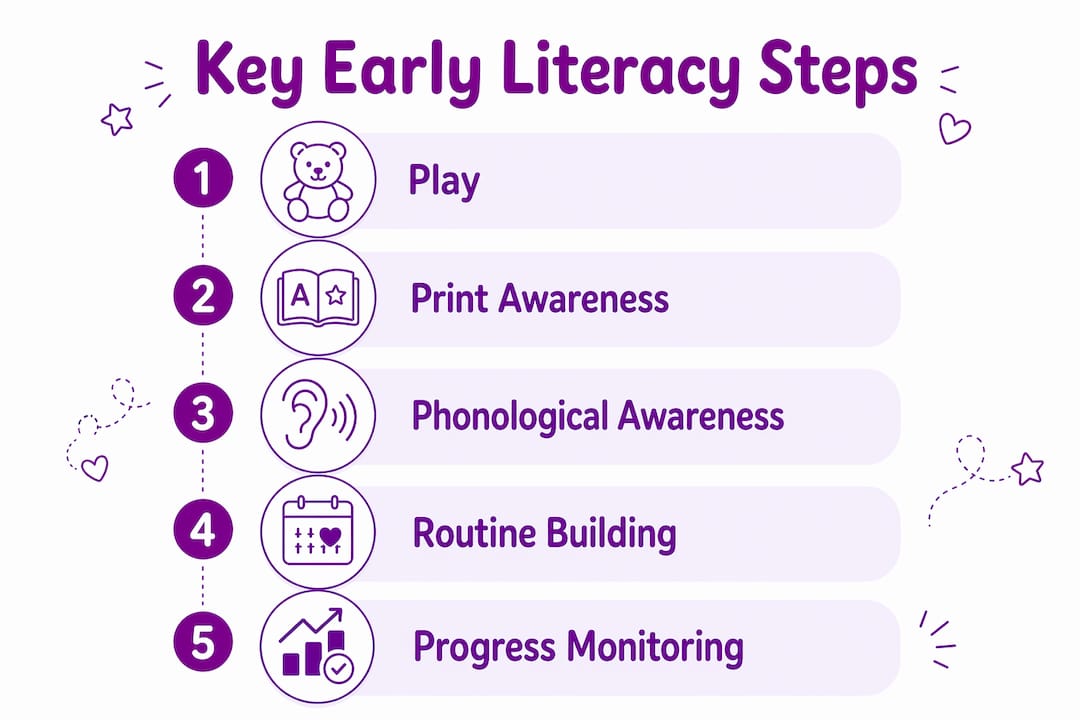
The most effective model for early literacy activities for toddlers is frequency plus micro-sessions. Multiple five-to-ten-minute sessions targeting the same phonological skill daily produce better outcomes than longer, less frequent practice. This fits perfectly into a 3-year-old’s attention span and your family’s real schedule.
Here is what a realistic daily literacy routine looks like:
- Morning: Point out one word on a food package during breakfast. Say it, spell it, say it again. Thirty seconds.
- Midday play: Do the first-sound treasure dig or a letter scavenger hunt for five minutes.
- Bedtime: Read one picture book together with finger tracking. Ask one prediction question: “What do you think happens next?”
The key is weaving literacy into moments that already exist, not carving out a separate “school time.” When reading feels like part of life rather than a task, children build a positive relationship with books and language that lasts.
Common mistakes parents make at this stage include pushing formal letter writing too early, relying on worksheets, and expecting their child to recognize all 26 letters by age 3. These expectations create frustration on both sides. The research is clear: print handling and sound awareness are the right targets now. Formal decoding comes in kindergarten. Your job at age 3 is to make language feel magical and safe.
Pro Tip: If your child resists an activity, drop it immediately and try again in a week. Resistance at this age almost always means the activity is not matching their current interest or energy, not that they are behind.
You can also explore writing readiness activities that complement phonological play without jumping ahead of your child’s development.
How to recognize your child’s early literacy progress
Progress at age 3 looks different from what most parents expect. You will not see your child reading sentences. You will see smaller, equally meaningful signs. Use this table to track what to look for and how to respond.
| Milestone | What it looks like | How to respond |
|---|---|---|
| Print directionality | Child holds book right-side up and turns pages front to back | Praise the behavior and model it consistently during shared reading |
| Environmental print recognition | Child recognizes a familiar logo or word on a sign | Point out more print in daily life and name what it says |
| Rhyme awareness | Child completes a rhyming pair or laughs at nonsense rhymes | Introduce more rhyming songs and books like those by Dr. Seuss |
| Initial sound identification | Child says “ball starts with /b/” | Expand to other sounds and try the first-sound treasure dig game |
| Pretend reading | Child “reads” a book from memory using pictures as cues | Celebrate this. It shows narrative understanding and print motivation |
When your child starts showing two or three of these behaviors consistently, you can gently introduce more structured activities. Try matching letter cards to objects, or pointing out the first letter of their name on signs and packages. Follow their lead. A child who is excited about letters will absorb them quickly. A child who is not ready yet will show you clearly, and that is completely normal.
Avoid comparing your child’s progress to siblings, neighbors, or social media timelines. The range of normal for early literacy development at age 3 is wide. What matters is consistent, joyful exposure, not speed. Celebrate every small success loudly. “You found the /s/ sound. That was amazing.” Positive reinforcement at this age shapes a child’s identity as a learner.
My honest take on starting literacy at age 3
Here is something I have noticed that most literacy guides skip over: the biggest obstacle to early literacy at age 3 is not a lack of activities. It is parental anxiety. Parents worry their child is behind, push harder, and accidentally turn reading into a stressful experience. The child then associates books with pressure, and the whole thing backfires.
The research points clearly toward play. But play requires you to let go of the outcome during the activity itself. Your job in a rhyming game is not to correct every wrong answer. It is to keep the energy light and the laughter coming. The learning happens in the repetition over days and weeks, not in any single session.
I also think parents underestimate how much environmental print exposure matters. You do not need expensive kits or apps. Your kitchen, your grocery store, and your neighborhood are full of print. Pointing to the word “STOP” on a stop sign every single day is a legitimate literacy activity. It teaches print carries meaning, that letters make sounds, and that reading is useful in real life.
The families I have seen make the most progress are not the ones doing the most activities. They are the ones who are the most consistent and the most relaxed. Five minutes of genuine, joyful engagement beats thirty minutes of reluctant drilling every time. Trust the process, follow your child’s cues, and remember that play-based learning is not the easy path. It is the right one.
— Bobby
Give your child a magical head start with Littlepumpkins
If your 3-year-old is showing early interest in letters and writing, Littlepumpkins has something truly special to offer. Their tracing and handwriting books use reusable magic ink technology, so children can practice letters again and again without wasting paper.
What makes Littlepumpkins stand out is the range of languages available, including English, Hindi, Punjabi, Gujarati, and Nepali. These books let your child connect with their cultural roots while building real writing skills, one magical letter at a time. They pair perfectly with the play-based literacy activities in this article. Explore the full range of tracing and writing books designed for preschoolers aged 3 to 6, and find the right fit for your family today.
FAQ
What does early literacy mean for a 3-year-old?
Early literacy at age 3 focuses on emergent skills like print awareness and phonological awareness, not formal reading. Children learn to handle books correctly, recognize environmental print, and play with sounds in spoken language.
How long should literacy activities be at age 3?
Five to ten minutes per session is developmentally appropriate and effective for 3-year-olds. Multiple short sessions spread across the day produce better results than one long session.
What are the best literacy games for 3-year-olds?
The first-sound treasure dig, rhyming song games, letter scavenger hunts, and shared book reading with finger tracking are among the most effective. These activities build phonological awareness and print awareness through movement and sensory play.
Should I teach my 3-year-old to read formally?
Formal reading instruction is not recommended at age 3. The focus should be on building foundational skills like sound recognition and print handling. Formal decoding typically begins in kindergarten when children are developmentally ready.
How do I know if my child is making literacy progress?
Look for signs like pretend reading, completing rhymes, recognizing their name in print, and holding books correctly. These early literacy milestones signal that foundational skills are developing on track.
Key takeaways
Starting early literacy activities at age 3 means building print awareness and phonological awareness through short, playful, daily routines rather than formal reading instruction.
| Point | Details |
|---|---|
| Focus on emergent skills | Target print awareness and phonological awareness, not letter decoding, at age 3. |
| Use play-based activities | Sensory games, rhyming songs, and scavenger hunts build skills better than worksheets. |
| Keep sessions short | Five to ten minutes daily, repeated across the week, produces the strongest results. |
| Track the right milestones | Pretend reading, rhyme completion, and print directionality are the real signs of progress. |
| Stay relaxed and consistent | Joyful, low-pressure exposure builds a positive relationship with reading that lasts for life. |