


Why Early Literacy Shapes Long-Term Learning
Early literacy is defined as the language, print, and cognitive skills children develop before formal schooling begins, and it is the single strongest predictor of long-term academic success. Reading proficiency by third grade makes children four times more likely to graduate high school. Yet only 31% of U.S. fourth graders currently read at a proficient level. That gap does not close on its own. The American Academy of Pediatrics endorses early literacy promotion as a core part of pediatric care, placing it alongside standard health markers. What happens in a child’s first six years of life sets the cognitive foundation for everything that follows.
Why early literacy shapes long-term learning: the brain science
Early literacy skills build the brain’s neural networks for language, memory, and reasoning. These networks form most rapidly between birth and age five. When children hear words, handle books, and trace letters, they activate and strengthen the same pathways they will use for reading comprehension, math reasoning, and critical thinking in later grades.
Early literacy skills act as stepping-stones that enable more complex learning, creating a compounding effect over a child’s life course. Each skill a child masters makes the next one easier to acquire. A toddler who learns to recognize letters gains an advantage in phonics. A preschooler who understands phonics reads words faster. A first grader who reads fluently comprehends more. The OECD describes this as the “dynamic complementarity” of early skills. In plain terms: early wins multiply.

Alphabetic knowledge is one of the most powerful early predictors of reading success. A nationwide U.S. study of 810,328 first graders found that 43% read below the 30-words-per-minute fluency threshold, signaling academic difficulty. That is nearly half of all first graders struggling before they have had a real chance to start. The same research showed that strong alphabetic principle knowledge compensates for low phonemic awareness in many children, helping them reach acceptable reading levels regardless.
Longitudinal research confirms the long reach of early skills. School readiness at age 5–6 strongly predicts academic performance all the way through age 14–15. That is nearly a decade of academic outcomes shaped by what a child knew before kindergarten.
- Letter recognition: Children who know most letters of the alphabet before kindergarten read significantly faster by the end of first grade.
- Phonemic awareness: The ability to hear and manipulate sounds in words is the clearest early signal of future reading ability.
- Vocabulary size: A larger spoken vocabulary at age three predicts stronger reading comprehension at age eight.
- Print motivation: Children who enjoy books and show curiosity about print engage more deeply with reading instruction.
Pro Tip: Read aloud with your child every day, even for just 10 minutes. Point to words as you read them. That simple act builds print awareness and letter recognition at the same time.
What are the economic and societal benefits of early literacy?
The impact of literacy on learning extends far beyond the classroom. Universal foundational literacy could generate a $196 trillion global economic impact over 20 years through higher earnings and greater productivity. That figure reflects what is currently being lost. In 2023, 78 million primary-aged children worldwide missed the critical literacy window entirely.
Early literacy also prevents costly educational failures down the line. Children who cannot read proficiently by third grade are more likely to repeat grades, disengage from school, and drop out before graduation. The “virtuous cycle” of early skill mastery reduces grade retention and boosts school engagement, improving the odds of sustained educational success. Preventing one child from falling behind saves families, schools, and communities real money and real heartbreak.
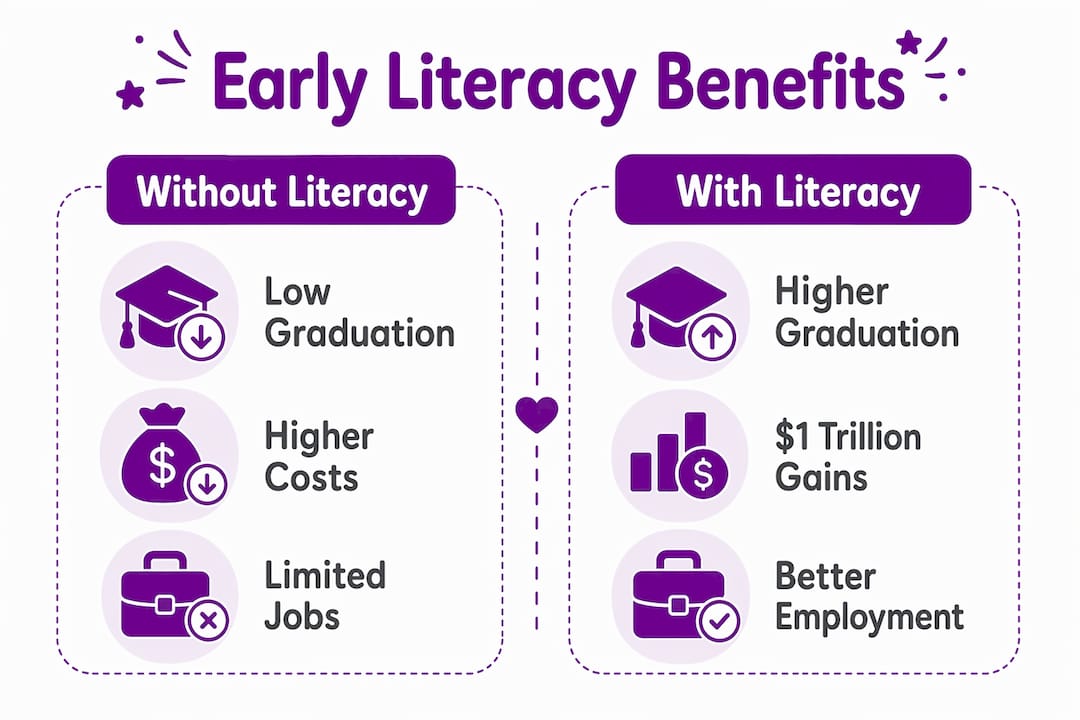
| Outcome | Without early literacy | With early literacy |
|---|---|---|
| High school graduation | Significantly lower likelihood | Four times more likely |
| Grade repetition | Higher risk | Substantially reduced |
| Lifetime earnings | Below average | Measurably higher |
| Civic participation | Lower engagement | Stronger community involvement |
The societal cost of low literacy is not abstract. Adults with weak foundational reading skills face barriers in employment, healthcare navigation, and civic life. Investing in early literacy is not a school policy choice. It is a public health decision.
How can parents and educators build early literacy skills?
The most effective literacy building happens before a child ever enters a classroom. Shared reading beginning at birth strengthens brain networks, deepens emotional bonds, and builds the language foundation children need for school. The American Academy of Pediatrics recommends reading aloud to children starting in infancy, not because babies understand the words, but because the rhythm, tone, and print exposure wire the brain for language.
Parents and educators can take practical steps at every stage of early childhood:
- Read aloud daily from birth. Choose books with repetition, rhyme, and bright illustrations. Repetition builds phonemic awareness naturally.
- Talk constantly during daily routines. Narrate what you are doing while cooking, dressing, or walking. Every new word a child hears expands their vocabulary.
- Point to letters in the environment. Signs, cereal boxes, and labels all count. Connecting letters to real life builds the alphabetic principle.
- Sing songs and recite nursery rhymes. Rhyming trains children to hear the sounds within words, which is the core of phonemic awareness.
- Let children “write” early. Scribbling, drawing, and tracing are the first steps toward writing readiness. The connection between early writing and reading is well established in literacy research.
- Ask open-ended questions about books. “What do you think happens next?” builds comprehension and oral language at the same time.
Illustrations matter more than most parents realize. Visual storytelling teaches children how narratives work, which directly supports reading comprehension. Books with rich, detailed pictures give children more to talk about and more language to absorb.
Pro Tip: Start literacy activities at age 3 with letter tracing and picture books that name objects clearly. Children this age are primed to connect sounds to symbols.
What are the key milestones in early literacy development?
Knowing what to look for helps parents and educators catch delays early and celebrate real progress. Early literacy development follows a general sequence, though children move through it at slightly different paces.
Birth to 12 months: Responds to voices, turns toward sounds, shows interest in faces and books. These are the earliest signs of language readiness.
12–24 months: Says first words, points to pictures in books, begins to understand that print carries meaning. A child who ignores books entirely at this stage is worth watching.
Age 2–3: Vocabulary grows rapidly. Children begin to recognize familiar logos and signs. They enjoy being read to and may “pretend read” by reciting memorized text.
Age 3–4: Recognizes some letters, especially those in their own name. Begins to understand that words are made of separate sounds. This is when phonemic awareness starts to emerge.
Age 4–5: Knows most letters of the alphabet and their sounds. Can rhyme words and identify beginning sounds. Starts to write letters, even if imperfectly.
Age 5–6: Begins to decode simple words. Reads familiar books independently. Writes recognizable letters and simple words.
Early literacy skills at school entry continue to predict academic outcomes years later, which is why pre-K support matters so much. If a child at age four cannot recognize any letters or shows no interest in books, that is a signal to seek a developmental screening. Early intervention works best when it starts early.
Pediatric literacy promotion by healthcare providers is now recognized as a critical tool for building relational health and literacy before formal education begins. Ask your child’s pediatrician about literacy screening at well-child visits.
Key Takeaways
Early literacy is the foundation of all future learning, and the skills children build before age six directly determine their academic trajectory through high school and beyond.
| Point | Details |
|---|---|
| Third-grade reading predicts graduation | Children who read proficiently by third grade are four times more likely to finish high school. |
| Alphabetic knowledge is a compensatory skill | Strong letter-sound knowledge helps children overcome low phonemic awareness and reach grade-level reading. |
| Economic stakes are enormous | Universal foundational literacy could generate $196 trillion in global economic value over 20 years. |
| Shared reading starts at birth | The American Academy of Pediatrics recommends reading aloud from infancy to build brain networks and language. |
| Early skills compound over time | School readiness at age 5–6 predicts academic performance through age 14–15, showing lasting developmental effects. |
What parents and educators get wrong about early literacy
The biggest mistake I see is waiting. Parents often assume literacy starts when a child enters kindergarten. Educators sometimes treat pre-K as purely social preparation. Both groups underestimate how much is already happening in a child’s brain between birth and age four.
The second mistake is treating literacy as a skill drill. Flashcards and worksheets can work, but they rarely build the love of reading that sustains a child through harder academic years. The children I have seen thrive are the ones whose parents made books feel magical, not mandatory. A child who wants to read will outperform a child who is made to read, every single time.
Bilingual and multilingual families have a particular advantage that often goes unrecognized. A child learning to trace letters in Punjabi or Hindi alongside English is not confused. They are building richer neural pathways, stronger phonemic awareness across sound systems, and a deeper connection to identity. That connection to cultural roots is not a distraction from literacy. It is fuel for it.
The most underused tool in early literacy is consistency. Ten minutes of shared reading every day beats a two-hour session on weekends. The brain learns language through repetition and routine, not intensity. Build the habit small and keep it joyful.
— Bobby
Littlepumpkins resources for early literacy at home
Children learn best when practice feels like play. Littlepumpkins designs books specifically for children aged 3 to 6, combining reusable magic ink technology with engaging illustrations that make letter tracing feel like a game, not a lesson.
The writing books for kids from Littlepumpkins cover tracing and handwriting practice across multiple languages, including English, Hindi, and Punjabi. Each book supports the alphabetic principle and fine motor development that research identifies as core early literacy skills. For families who want to nurture bilingualism alongside writing readiness, the Hindi tracing books offer a warm, culturally connected way to build those skills one magical letter at a time. Every page is reusable, so children can practice as many times as they need without pressure.
FAQ
What is early literacy and why does it matter?
Early literacy is the set of language, print, and cognitive skills children develop before formal reading instruction begins. These skills directly predict reading proficiency, school readiness, and long-term academic success.
At what age should I start building literacy skills with my child?
Start at birth. The American Academy of Pediatrics recommends reading aloud from infancy, since early exposure to language and print builds the brain networks children need for reading.
What are the most important early literacy skills to develop?
Phonemic awareness, alphabetic knowledge, vocabulary, and print motivation are the strongest predictors of later reading success. Alphabetic knowledge is especially powerful because it can compensate for weaker phonemic awareness.
How does early literacy affect long-term school performance?
School readiness skills at age 5–6 predict academic performance through age 14–15. Children who read proficiently by third grade are four times more likely to graduate high school.
How can I tell if my child needs extra literacy support?
If your child shows no interest in books, cannot recognize any letters by age four, or struggles to rhyme simple words by age five, ask your pediatrician for a developmental screening. Early intervention produces the strongest results.