


Why Reusable Writing Books Outperform Worksheets for Kids
Reusable writing books are defined as multi-use practice tools that let children trace, write, and erase letters repeatedly without consuming new paper each time. They outperform traditional worksheets because they combine tactile engagement, cyclical repetition, and physical feedback in ways that single-use paper simply cannot match. Research from Edutopia shows that handwriting students scored 92% accuracy compared to 76% for those using typing or passive methods. That 16-point gap is not a small difference. It reflects how deeply the physical act of writing shapes a child’s ability to learn and retain language. Littlepumpkins builds on this science with magic ink books designed for children aged 3–6, making reusable writing tools both practical and genuinely fun.
Why reusable writing books outperform worksheets for handwriting accuracy
The accuracy advantage of reusable writing books comes from how the brain processes physical handwriting. Handwriting integrates fine motor skills, neuromotor processes, and cognitive encoding in a way that typing or tracing on flat paper does not. When a child grips a pen and follows a grooved letter path, the brain fires across multiple regions at once. That multi-region activation builds stronger memory traces for each letter or word.
Worksheets ask children to complete a task once and move on. Reusable books ask them to return to the same letters again and again, which is exactly how motor skills develop. Think of it like learning to ride a bike. One attempt does not build the skill. Repeated attempts on the same path do.
“The physical act of forming letters by hand activates areas of the brain associated with reading and language in ways that keyboard input simply does not replicate. Repeated handwriting practice is not just a motor task. It is a language-learning event.”
This is why the 92% accuracy figure matters so much for parents and educators. Children who practice handwriting with physical tools do not just write more neatly. They read and process language more effectively. Reusable books make that level of practice possible every single day without running out of pages.
How tactile feedback builds focus and better writing habits
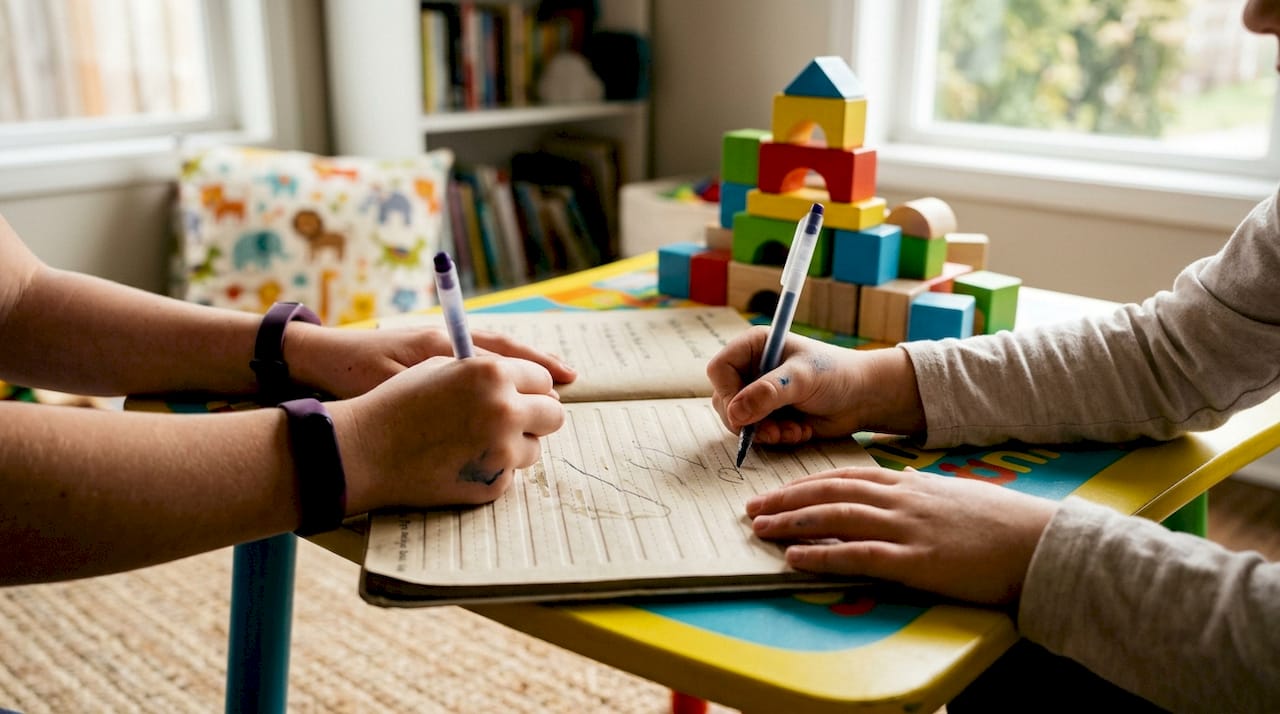
Tactile cues are the physical sensations a child feels when pressing a pen against a grooved or textured surface. Reusable tools provide consistent tactile cues that support concentration and mindful learning habits in young children. A flat worksheet offers no such feedback. A screen offers even less. When a child feels the groove of a letter beneath their pen, their attention locks onto the task in a way that passive paper cannot produce.
Educational psychology research on tactile learning confirms that physical sensation during practice strengthens habit formation. Children who associate a specific physical feeling with a learning task return to that task more willingly. That is why Littlepumpkins designs its books with grooved letter guides rather than plain printed lines.
Pro Tip: Place the reusable book at the same spot on the table every practice session. Consistent physical context, the same seat, the same book, the same pen, reinforces the habit loop and helps children settle into focus faster.
Here is what tactile feedback in reusable writing books does that worksheets cannot:
- Creates a physical sensation that anchors attention to the task
- Guides pen pressure and stroke direction through grooved letter paths
- Reduces frustration because children feel when they are on track
- Builds muscle memory through the same physical motion repeated across sessions
- Signals “practice time” as a recognizable, calming routine rather than a chore
Worksheets and digital screens both remove this layer of physical engagement. A child filling in a printed worksheet gets no feedback from the page itself. The pen glides across flat paper with no guidance. Reusable books with textured grooves act more like a coach than a blank canvas.
Do reusable books build better long-term skills than one-time worksheets?
The answer is yes, and the reason is cyclical learning. Cyclical learning, revisiting the same pages repeatedly, builds muscle memory more effectively than linear worksheet completion. A worksheet is designed to be finished and discarded. A reusable book is designed to be returned to, which matches exactly how the brain consolidates motor skills.
Linear task completion, the worksheet model, teaches children that a skill is “done” once the page is filled. That framing works against long-term mastery. Writing is not a task you complete. It is a skill you build through repetition over weeks and months.
A cyclical routine looks like this:
- Day 1: Child traces the letter “A” in the reusable book, feeling the groove and building the first motor impression.
- Day 2: Child returns to the same page. The motion feels slightly more familiar. The brain reinforces the memory trace.
- Day 5: The stroke feels natural. The child begins to write the letter without needing to look at the guide.
- Day 10: Muscle memory is forming. The child can reproduce the letter in other contexts, not just in the book.
- Week 4: The skill is consolidated. The child moves to the next letter with a proven method already in place.
Reusable practice books support continuous skill improvement all year long without consuming additional resources. That is a structural advantage no stack of worksheets can replicate. Parents and educators who use reusable books are not just saving paper. They are building a learning system that compounds over time.
Environmental and practical advantages of reusable writing books
Reusable writing books reduce paper waste and lower costs over time compared to disposable worksheets. Reusable notebooks reduce waste and clutter while offering real cost savings for families and classrooms. A single reusable book can replace dozens of printed worksheet packets across a school year. That reduction matters both for household budgets and for the environment.
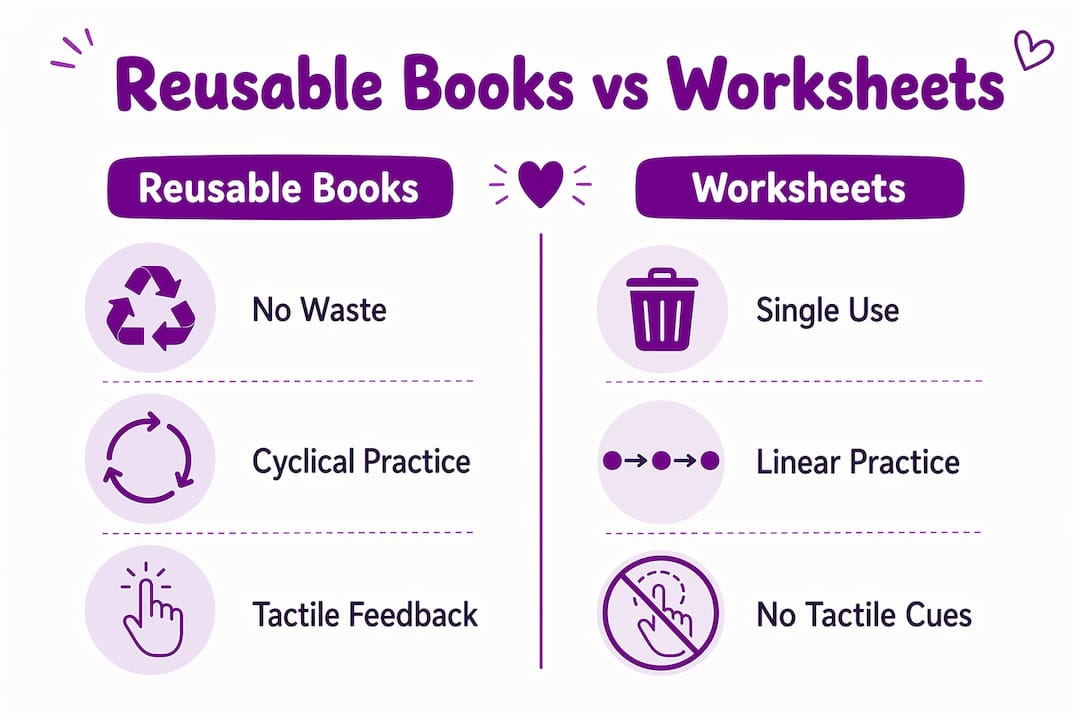
The practical benefits for parents and educators are equally clear. Worksheets require printing, organizing, and storing. They pile up. They get lost. Reusable books sit on a shelf, ready to use at any moment, with no prep required.
| Feature | Reusable writing books | Single-use worksheets |
|---|---|---|
| Paper consumption | None after initial purchase | New paper required every session |
| Cost over time | One-time purchase, reused indefinitely | Ongoing printing or purchasing cost |
| Prep required | None | Printing, cutting, or sourcing |
| Correction method | Wipe clean or disappearing ink | Cross out or discard |
| Storage | One book per skill set | Growing stacks of paper |
| Child engagement | High, due to tactile and visual appeal | Moderate, declines with repetition |
Magic disappearing ink pens in reusable books allow mess-free, repeated practice without wiping. Children can write, watch the ink fade, and write again. That cycle of instant reset keeps young learners engaged in a way that crossing out mistakes on a worksheet never does. For parents managing busy mornings, the no-prep, no-mess format of a reusable book is a genuine time saver.
Key Takeaways
Reusable writing books outperform worksheets because they combine tactile feedback, cyclical repetition, and zero-waste design to build stronger handwriting and language skills in young children.
| Point | Details |
|---|---|
| Handwriting accuracy advantage | Children using tactile handwriting tools score 16 points higher in accuracy than those using passive methods. |
| Tactile cues build focus | Grooved pages and physical feedback anchor a child’s attention and guide correct stroke formation. |
| Cyclical practice beats linear tasks | Returning to the same pages repeatedly builds muscle memory faster than completing and discarding worksheets. |
| Cost and waste reduction | One reusable book replaces dozens of worksheet packets, saving money and reducing paper clutter. |
| Engagement stays high | Disappearing ink and tactile design keep children motivated to practice, session after session. |
What I’ve learned from watching kids use reusable books versus worksheets
I’ve watched children sit down with a fresh worksheet and finish it in two minutes, then push it aside and ask what’s next. That “what’s next” moment is the problem. The worksheet signals completion. The learning stops.
With a reusable book, something different happens. Children want to do it again. The magic ink fading away and reappearing feels like a game. The groove under the pen feels satisfying. They ask to practice, rather than waiting to be asked. That shift in motivation is not a small thing. Motivation is the engine of skill development in young children.
I’ve also seen how the environmental angle resonates with parents. Families who care about reducing waste find real comfort in knowing that one book serves their child for an entire year or longer. There is no guilt about printing another stack of pages. The book is always ready, always clean, and always waiting.
My honest recommendation: start with one reusable book focused on a single skill, such as letter tracing in your child’s home language. Build the daily habit around that one book before adding more. Consistency with one tool beats variety across many.
— Bobby
Littlepumpkins reusable writing books: built for real practice
Littlepumpkins makes reusable writing books specifically for children aged 3–6 who are learning to write in English, Hindi, Punjabi, and other languages. Each book features grooved letter guides, magic disappearing ink pens, and vibrant illustrations that make practice feel like play rather than schoolwork.
There is no printing, no prep, and no mess. Children pick up the pen, trace the letters, watch the ink fade, and go again. Parents who want to support bilingual learning at home will find books designed for exactly that purpose. Educators looking for a no-waste classroom tool get a resource that lasts all year. Browse the full range of reusable writing books to find the right fit for your child’s language and skill level. The English tracing book is a great starting point for young writers building their first alphabet skills.
FAQ
Why do reusable writing books improve handwriting accuracy?
Reusable books provide grooved tactile feedback and allow repeated practice on the same letters, which builds muscle memory and neuromotor coordination. Research shows children using physical handwriting tools achieve 92% accuracy compared to 76% with passive methods.
How are reusable writing books different from worksheets?
Worksheets are single-use and linear, designed to be completed once and discarded. Reusable books support cyclical practice, letting children return to the same pages repeatedly to reinforce skills over time.
Are reusable writing books better for the environment?
Yes. A single reusable book replaces dozens of printed worksheet packets across a school year, reducing paper waste and lowering the ongoing cost of practice materials for families and classrooms.
What age group benefits most from reusable writing books?
Children aged 3–6 benefit most, as this is the critical window for fine motor skill development and early language encoding. Littlepumpkins designs its books specifically for this age range.
Can reusable writing books support bilingual learning?
Yes. Books designed with letter guides for multiple languages, such as those from Littlepumpkins covering English, Hindi, and Punjabi, allow children to practice writing in their heritage language alongside their primary school language.