


Why Tracing Precedes Independent Letter Formation
Tracing is defined as the foundational motor scaffold children use to develop the hand movements required for fluent, independent letter formation. Before a child can write the letter “A” from memory, their hand needs to know what that movement feels like. Tracing provides that physical experience. Understanding why tracing precedes independent letter formation helps parents and educators make smarter decisions about early writing practice. Research on handwriting development confirms that children who build motor memory through guided tracing transition to independent writing more confidently and accurately than those who skip this stage.
Why tracing precedes independent letter formation
Tracing gives children a physical route to follow before their brains can generate that route independently. Think of it like training wheels on a bike. The wheels do not teach balance on their own, but they let a child feel what balance is supposed to feel like. Tracing works the same way for handwriting.
The technical term for what tracing builds is an internal motor plan. A motor plan is the brain’s stored sequence of movements for a specific task. When a child traces the letter “B,” their hand learns the starting point, the downward stroke, and the two bumps. Repeat that enough times, and the brain stores it as a reliable movement pattern.
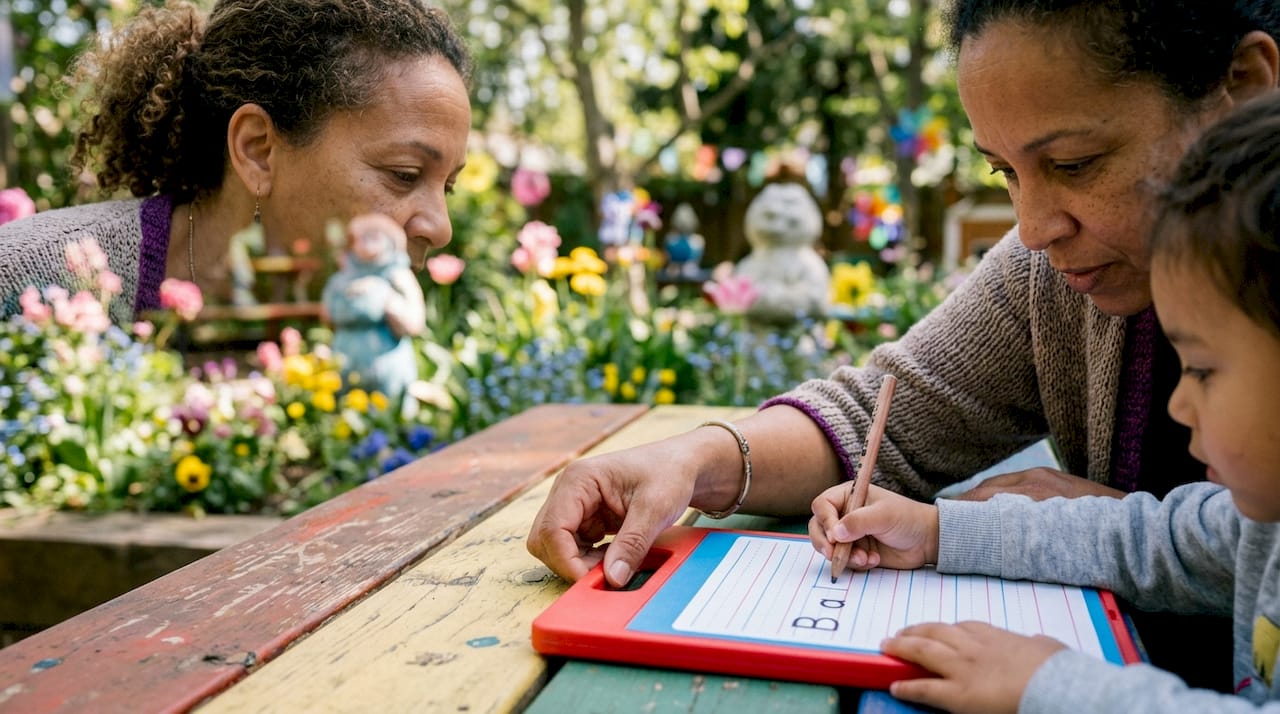
Fine motor control is the physical side of this process. Children aged 3–6 are still developing the small muscle strength and coordination in their fingers and wrists that writing demands. Pre-writing strokes develop these fine motor skills before children form actual letters. This is why circles, lines, and curves come before alphabet practice in most early childhood programs.
How muscle memory forms through guided tracing
Muscle memory in writing is not stored in the muscles themselves. It lives in the brain’s motor cortex as a learned sequence. Tracing activates this sequence repeatedly, which is exactly how muscle memory develops in young writers. Each repetition strengthens the neural pathway associated with that letter’s shape.
The key benefit is consistency. When a child traces the same letter shape multiple times, their hand learns to reproduce it with less conscious effort. That reduced effort is what educators call automaticity. Automaticity in letter formation frees up mental energy for the harder work of spelling, vocabulary, and expressing ideas.
- Tracing reinforces the correct starting point for each letter.
- It teaches stroke direction, which prevents reversal errors like confusing “b” and “d.”
- It builds hand strength through repeated, purposeful movement.
- It connects visual recognition of a letter with the physical act of forming it.
Pro Tip: Ask your child to say the letter name out loud while tracing it. This links the sound, the shape, and the movement all at once, which deepens the learning.
Common misconceptions about tracing in literacy development
Tracing is not about staying perfectly inside the lines. That is the most common misunderstanding parents and educators hold. When a child focuses entirely on visual tracking, staying “in the lines,” they are focusing on visual control rather than internalizing the letter’s shape and movement. The result is slow, segmented writing that does not transfer to free writing.
Handwriting Heroes calls this the tracing trap. A child can trace a letter perfectly every time and still be unable to write it independently. That happens because tracing mimics external control rather than building the internal motor plan the child actually needs.
Here are the most common myths about tracing, and what the research actually shows:
- Tracing must be mastered before any independent writing begins. False. Transcription and composition should develop at the same time. Children who only trace and never attempt free writing can develop a transcriptional bottleneck, where their handwriting skill lags so far behind their ideas that writing becomes frustrating.
- More tracing always means better writing. False. Tracing is a scaffold, not an endpoint. Overusing it without fading the support delays the development of independent motor planning.
- Tracing teaches children how letters are formed. Partially true. Tracing teaches the feel of a movement, but only if the child is paying attention to the movement itself, not just the visual path.
- Children who struggle with tracing are not ready to write. False. Tracing difficulty often signals a need for more pre-writing stroke practice, not a reason to delay all writing activities.
The Writing For Pleasure Centre warns that exclusive tracing practice without free writing limits composition skills. Children need space to experiment with letters, even imperfectly, alongside their tracing practice.
How to transition from tracing to independent letter formation
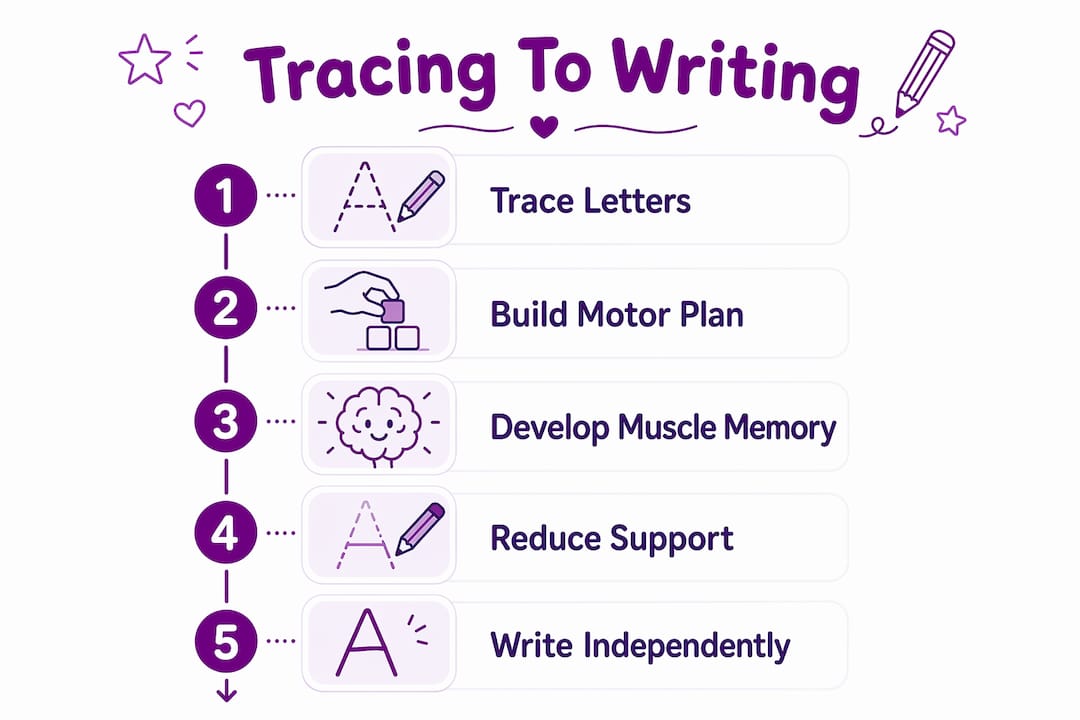
The transition from tracing to independent writing follows a clear progression. Rushing this process creates gaps in motor planning. Moving too slowly creates dependence on visual guides. The goal is a gradual fade of support that builds confidence at each stage.
Skilled educators use a four-stage model for fading tracing supports progressively:
- Full tracing. The child traces a complete dotted or outlined letter. This is the starting point for new letter shapes.
- Partial tracing. Only the starting dot or first stroke is provided. The child completes the rest independently.
- Copying. The child looks at a model letter and reproduces it without any tracing guide.
- Independent recall. The child writes the letter from memory with no visual reference.
Each stage requires the child to take on more motor planning responsibility. That ownership is what builds fluency.
Pro Tip: Watch for the moment your child starts a letter without looking at the guide. That is the signal they are ready to move to the next stage.
Activities beyond tracing also build the physical and cognitive skills writing requires. Varied sensory activities like drawing in sand, finger painting, or using clay strengthen fine motor control and letter recognition. These activities engage different senses and reinforce the same movement patterns tracing builds, without the visual dependency risk.
Avoid the common mistake of keeping dotted letter guides in place long after a child has mastered a letter shape. Once a child can copy a letter accurately, the full tracing guide is no longer helping. It may actually slow the development of independent motor planning by keeping the child’s attention on the visual path rather than the internal movement.
| Stage | Support level | Child’s role |
|---|---|---|
| Full tracing | High | Follows complete letter outline |
| Partial tracing | Medium | Completes letter from a starting point |
| Copying | Low | Reproduces model without guide |
| Independent recall | None | Writes from memory |
What are the broader educational benefits of starting with tracing?
Tracing supports far more than handwriting. When children trace letters, they internalize letter shapes and patterns, which directly supports letter recognition. Letter recognition is one of the strongest early predictors of reading success.
The connection between tracing and phonics is direct. When a child traces the letter “S” while hearing its sound, they are building a sound-to-symbol link. That link is the foundation of decoding, the skill readers use to sound out unfamiliar words. Tracing makes that connection physical and memorable.
Confidence is another underrated benefit. Early writing attempts are often frustrating for young children because the gap between what they want to write and what their hand can produce feels enormous. Tracing closes that gap temporarily. It gives children a successful writing experience before their fine motor skills are fully developed. That success builds the willingness to keep trying.
Letter recognition activities that pair tracing with phonics instruction produce stronger early literacy outcomes than either approach alone. The physical act of forming a letter while connecting it to a sound creates a richer memory trace than visual recognition alone.
| Developmental benefit | How tracing supports it |
|---|---|
| Letter recognition | Repeated tracing reinforces shape memory |
| Phonics readiness | Links letter shape to sound during practice |
| Writing confidence | Provides early success before full motor control develops |
| Reading readiness | Builds symbol awareness used in decoding |
| Fine motor development | Strengthens hand muscles through purposeful movement |
Key takeaways
Tracing precedes independent letter formation because it builds the internal motor plans children need to write fluently, but only when it is used as a temporary scaffold that fades progressively toward full independence.
| Point | Details |
|---|---|
| Tracing builds motor plans | Repeated tracing creates the brain’s stored movement sequence for each letter shape. |
| Fading support is critical | Move from full tracing to partial guides, copying, and then independent recall to build fluency. |
| Avoid the tracing trap | Children who focus only on staying in lines may not internalize letter formation. |
| Combine tracing with free writing | Concurrent transcription and composition practice prevents developmental bottlenecks. |
| Tracing supports literacy broadly | Letter recognition, phonics, and writing confidence all improve with well-structured tracing practice. |
What I have learned about tracing after watching hundreds of children write
Most parents and educators treat tracing as a simple warm-up activity. I used to think the same thing. After watching children at many different stages of writing development, I changed my view completely.
The children who struggled most with independent writing were not the ones who had done too little tracing. They were the ones who had done too much of it, without ever being pushed to write on their own. They had learned to follow a path, not to create one. That distinction matters more than most curricula acknowledge.
The children who thrived were the ones whose teachers and parents treated tracing as a conversation, not a task. They asked questions like, “Where does this letter start?” and “Which way does the curve go?” Those questions forced children to think about the movement, not just follow it. That thinking is what builds the internal motor plan.
My honest advice: use tracing generously in the early stages, but watch your child closely. The moment they can copy a letter accurately without a guide, move them forward. Do not wait for perfection. Waiting too long at any stage costs more than moving slightly too early.
— Bobby
Littlepumpkins makes the tracing-to-writing journey magical
If you are looking for a way to make tracing practice feel less like homework and more like play, Littlepumpkins has built exactly that. Their reusable magic ink books let children aged 3–6 trace letters in English, Hindi, Punjabi, and more, with illustrations that keep kids genuinely excited to pick up the pen again.

The books are designed around the same scaffold-and-fade approach this article describes. Children start with full letter tracing and build toward confident, independent writing, one magical letter at a time. Parents and educators can explore the full range of writing practice books to find the right fit for their child’s stage and language background. For families raising bilingual children, the English tracing book is a warm, engaging place to start.
FAQ
Why does tracing come before independent writing?
Tracing gives children a guided movement experience that builds the internal motor plan needed for independent letter formation. Without that foundation, children lack the muscle memory to reproduce letters accurately on their own.
What is the tracing trap?
The tracing trap occurs when children focus on staying inside dotted lines rather than internalizing the letter’s movement pattern. This produces visually acceptable tracing but poor transfer to free writing.
How do I know when my child is ready to stop tracing?
A child is ready to reduce tracing support when they can copy a letter accurately from a model without any guide. Writing readiness signs include consistent stroke direction and the ability to start a letter at the correct point without prompting.
Can too much tracing slow down writing development?
Yes. Exclusive tracing without free writing practice can create a transcriptional bottleneck, where handwriting skill lags behind a child’s ideas and expression. Pairing tracing with emergent writing activities prevents this.
Does tracing help with reading as well as writing?
Tracing reinforces letter recognition and builds the sound-to-symbol connections that underpin phonics. Children who trace letters while hearing their sounds develop stronger decoding skills, which directly supports early reading.