


Writing Developmental Milestones for Kids: A Parent's Guide
A developmental milestone for writing is a specific skill or behavior that marks a child’s progress along the path from early scribbling to conventional written language. These milestones follow a predictable sequence, even when the timing varies from child to child. Voyager Sopris Learning and North Shore Pediatric Therapy both identify five core stages that unfold between 15 months and age 8. Understanding where your child sits in this sequence helps you offer the right kind of support at the right time, without pressure and without guesswork.
What is a developmental milestone for writing?
A writing developmental milestone is a recognizable checkpoint in a child’s growing ability to communicate through marks, symbols, and letters. The term comes from the broader field of child development, where milestones describe expected skills at approximate ages. For writing specifically, these stages begin as early as 15 months with random mark-making and progress through conventional spelling by ages 6–8.
The transition from drawing to writing is gradual. A child does not simply pick up a pencil one day and start forming letters. The process involves both physical skill development and a growing symbolic understanding that marks carry meaning. That shift, from scribble to symbol, is the heart of early writing development.

Recognizing these milestones matters because it tells you what is developmentally normal. A 3-year-old who draws loops and lines is not “behind.” She is exactly where she should be. Knowing that gives you confidence to celebrate what she is doing rather than worry about what she is not.
What are the main stages of writing development in young children?
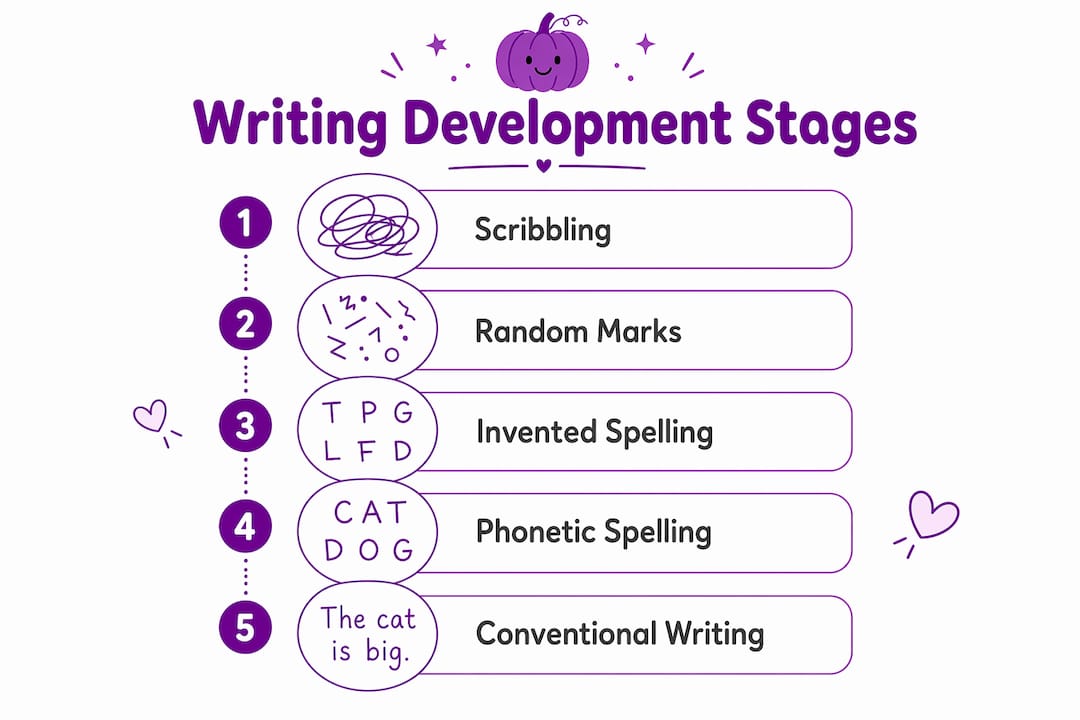
Writing development follows five stages, and each stage builds directly on the one before it. The stages are pre-phonemic, early phonemic, strings of random letters, invented or transitional spelling, and conventional writing.
| Stage | Typical Age | Key Skill | Example |
|---|---|---|---|
| Pre-phonemic | 15 months–3 years | Random marks and scribbles | Wavy lines, loops |
| Early phonemic | 3–4 years | Letter-like shapes appear | Circles, crosses, mock letters |
| Random letter strings | 4–5 years | Real letters, no sound match | “BKRTM” for any word |
| Invented spelling | 5–6 years | Letters match sounds | “KAT” for cat |
| Conventional writing | 6–8 years | Standard spelling and punctuation | “The cat sat.” |
The pre-phonemic stage starts with pure motor exploration. Children enjoy the physical act of making marks without attaching meaning to them. By the early phonemic stage, they begin to understand that writing is different from drawing, and letter-like shapes start appearing in their work.
The invented spelling stage is where phonological awareness becomes visible. Children apply what they know about sounds to produce spellings like “WNT” for “went” or “LUVU” for “love you.” Invented spelling reflects genuine phonics knowledge, even when the result looks nonstandard. This stage is a sign of progress, not a problem to fix.
Pro Tip: When your child writes “FRND” for “friend,” resist the urge to correct it. That spelling shows they hear the sounds in the word. Celebrate it as a real milestone.
How do fine motor skills and hand strength support writing milestones?
Fine motor development is the physical foundation of every writing milestone. Before a child can form a letter, she needs the hand strength, coordination, and control to hold a tool and direct it with intention. Fine motor milestones follow their own timeline, beginning with imitating scribbles at 12–18 months and progressing to copying shapes and practicing letters by ages 4–5.
Hand dominance, meaning a consistent preference for one hand, typically establishes itself between ages 3 and 6. By age 5, most children show a clear dominant hand. This matters because consistent tool grip is necessary for building the muscle memory that letter formation requires.
Pediatric occupational therapists recommend play-based activities as the most effective way to build these foundations. Many caregivers underestimate how much physical preparation writing actually demands. The good news is that the best preparation looks nothing like worksheets.
Here are activities that build the fine motor skills children need for writing:
- Tearing and crumpling paper builds hand strength and finger coordination.
- Using large crayons and chalk develops grip control without straining small hands.
- Stamping with ink pads practices the downward pressure used in letter formation.
- Threading beads or lacing cards trains the pincer grip essential for pencil hold.
- Playing with playdough strengthens the small muscles of the palm and fingers.
- Drawing on vertical surfaces like chalkboards or easels builds shoulder and wrist stability.
Pro Tip: Offer your toddler chunky crayons before thin pencils. Thick tools are easier to grip and reduce frustration, which keeps children willing to practice longer.
What is the typical timeline for writing milestones, and how much variation is normal?
The typical writing milestones timeline gives parents a useful reference point, not a strict deadline. Age benchmarks from North Shore Pediatric Therapy show that most children imitate scribbles between 12 and 18 months, begin practicing letters in their own name around age 5, write the full alphabet by age 6, and avoid letter reversals while using punctuation by age 7.
| Age | Expected milestone |
|---|---|
| 12–18 months | Imitates scribbles on paper |
| 19–24 months | Imitates vertical and horizontal strokes |
| 3 years | Copies a circle; draws basic shapes |
| 4 years | Copies a cross and square; draws a person |
| 5 years | Establishes hand dominance; writes own name |
| 6 years | Writes full alphabet; copies simple sentences |
| 7 years | No letter reversals; uses basic punctuation |
Individual variation is wide and completely normal. One child may write her name at 4. Another may not manage it until 5 and a half. Writing development is a long process where rushing milestones does more harm than good. Patience and consistent encouragement produce better outcomes than drills or pressure.
Letter reversals, such as writing “b” as “d,” are normal up to age 7. They reflect how the brain is still learning to process directionality, not a sign of a learning problem. If reversals persist past age 7 or are accompanied by other concerns, a conversation with a pediatric occupational therapist is worth having.
Early intervention is most effective when writing delays are caught before formal schooling begins. Warning signs include persistent avoidance of drawing or writing, poor hand coordination by age 4, and no clear hand dominance by age 5. Catching these early gives children the best chance to build confidence before classroom demands increase.
How can parents support writing development at home?
The most effective home environment for writing development is one that is low-pressure, print-rich, and full of varied materials. Open-ended opportunities with diverse art tools, from chalk to stamps to large crayons, support development across every stage. The goal is to make writing feel like play, not work.
Here is a practical daily routine that supports writing milestones:
- Set up a writing corner. Keep crayons, markers, paper, and chalk accessible at child height. Availability removes the barrier to spontaneous practice.
- Label your child’s drawings. Ask what the picture shows, then write the word next to it. This connects spoken language to written symbols in a natural way.
- Encourage invented spelling. When your child wants to write something, ask “What sounds do you hear?” rather than spelling it out for them.
- Read together daily. Pointing to words as you read builds print awareness, which directly supports writing readiness. You can find writing readiness activities that pair well with shared reading.
- Offer tracing practice. Tracing letters builds muscle memory for letter formation without the cognitive load of spelling. Start with large, simple shapes before moving to letters.
- Celebrate every attempt. Stick drawings on the fridge. Read invented spelling aloud with enthusiasm. Children write more when they feel their efforts are valued.
Balancing skill practice with creative expression is the key principle here. A child who writes freely, even messily, is building confidence and motivation. Both matter as much as correct letter formation. For more ideas on building these skills at home, Littlepumpkins has a guide on preschool writing readiness skills that parents find genuinely useful.
Key takeaways
Writing developmental milestones follow a predictable five-stage sequence from scribbling to conventional writing, and the most effective parental role is encouragement over correction at every stage.
| Point | Details |
|---|---|
| Five clear stages exist | Writing progresses from pre-phonemic scribbles to conventional spelling between ages 15 months and 8 years. |
| Fine motor skills come first | Hand strength and grip control must develop before letter formation is physically possible. |
| Invented spelling is progress | Children who spell phonetically are demonstrating real phonological awareness, not making errors. |
| Timelines vary widely | Letter reversals are normal until age 7; hand dominance typically sets by age 5. |
| Low-pressure environments win | Children who write freely and receive encouragement build stronger long-term writing skills. |
What I’ve learned from watching children write before they “know how”
The biggest mistake I see parents make is treating the scribbling stage as something to get through quickly. That stage is not a waiting room. It is where children discover that their hands can make marks that mean something. That discovery is the entire foundation of literacy.
Correcting invented spelling is the second most common misstep. Phonological awareness is the developmental priority at that stage, not spelling accuracy. When you correct “LUVU” to “love you,” you are teaching your child that their attempt was wrong. What they actually did was remarkable. They heard sounds and matched letters to them. That is exactly what they were supposed to do.
The children I have seen thrive as writers share one thing in common. They had adults around them who got genuinely excited about a page full of loops and squiggles. Enthusiasm is contagious. A child who sees you celebrate their scribble will pick up that crayon again tomorrow.
Fine motor readiness is the piece most parents overlook entirely. Writing is a physical skill before it is an academic one. If a child struggles to hold a crayon comfortably, no amount of letter practice will help. Play with playdough. Do the bead threading. Let them tear paper. That is writing preparation, even when it looks nothing like writing.
And if something feels off, trust that instinct. Early occupational therapy for children with fine motor delays makes a real difference before school begins. Asking for support is not an overreaction. It is good parenting.
— Bobby
Explore Littlepumpkins writing tools for early learners
Your child’s writing journey deserves tools that make practice feel magical, not like a chore. Littlepumpkins designs tracing and handwriting books specifically for children ages 3 to 6, using reusable magic ink technology so kids can practice letters again and again without wasting paper.

The books cover English, Hindi, Punjabi, and more, making them perfect for families who want to build bilingual writing skills alongside cultural connection. Each page pairs engaging illustrations with letter tracing so children stay motivated through every stage. Visit Littlepumpkins to explore the full range of learning tools for kids and find the right fit for where your child is right now.
FAQ
What is a developmental milestone for writing?
A developmental milestone for writing is a specific skill that marks a child’s progress from early scribbling to conventional written language. These milestones follow a predictable sequence starting as early as 15 months.
When do kids start writing recognizable letters?
Most children begin forming recognizable letters around age 4–5, typically starting with the letters in their own name. Full alphabet writing usually develops by age 6.
Is invented spelling a sign of a writing problem?
Invented spelling is a positive milestone, not a problem. It shows that a child is applying phonological awareness by matching letters to the sounds they hear in words.
How can I tell if my child has a writing delay?
Warning signs include persistent avoidance of drawing or writing, poor hand coordination by age 4, and no established hand dominance by age 5. A pediatric occupational therapist can assess and support children showing these signs.
What activities build writing readiness at home?
Activities like playdough, bead threading, drawing on vertical surfaces, and tracing with large crayons all build the fine motor skills children need before formal writing begins. You can also explore writing readiness in toddlers for early signs to watch for.